

Author: VitaWeller Health & Wellness Editorial Team
Evidence Reviewed: Peer-reviewed studies, systematic reviews, and guidance from recognized health organizations (NIH, NCCIH, ADA, Mayo Clinic).
Editorial Standards: Evidence-based • Independently researched • Fact-checked before publication
Introduction
Semaglutide and tirzepatide are widely discussed prescription medications for weight management and type 2 diabetes. Both affect appetite and blood sugar regulation, but they are not the same drug. Semaglutide activates the GLP-1 receptor; tirzepatide activates both GIP and GLP-1 receptors. The brand and formulation on a prescription also determine its approved uses.
This comparison explains their mechanisms, weight-loss and diabetes evidence, side effects, costs, and the distinction between approved and compounded preparations. For broader context, see our guide to Medical weight loss and GLP-1 treatments.
The direct comparisons discussed below studied once-weekly injections, not oral semaglutide. Oral semaglutide products have separate labels and dosing schedules; results from an injectable trial should not be presented as a head-to-head comparison of tablets.
What Evidence Does This Comparison Use?
Evidence Level: ★★★★☆ Strong for average outcomes during treatment, with important limits
- Direct evidence: SURMOUNT-5 compared the drugs for weight loss in adults without diabetes, while SURPASS-2 compared them in adults with type 2 diabetes.
- Indirect evidence: STEP 1 and SURMOUNT-1 each compared one medication with placebo. Their percentages should not be treated as a controlled comparison between the drugs.
- Study limits: the trials used specific doses, eligibility criteria, treatment durations, and follow-up plans. Their average results do not predict an individual’s outcome.
- Safety and applicability: prescribing information remains the reference for approved uses and precautions, and results from approved products cannot automatically be applied to compounded preparations.
SURMOUNT-5 and SURPASS-2 were open-label trials, meaning participants and investigators knew the assigned treatment. Both were funded by Eli Lilly. Their results are informative, but the population, doses, duration, and endpoints matter. [1] [2]
Quick Answer
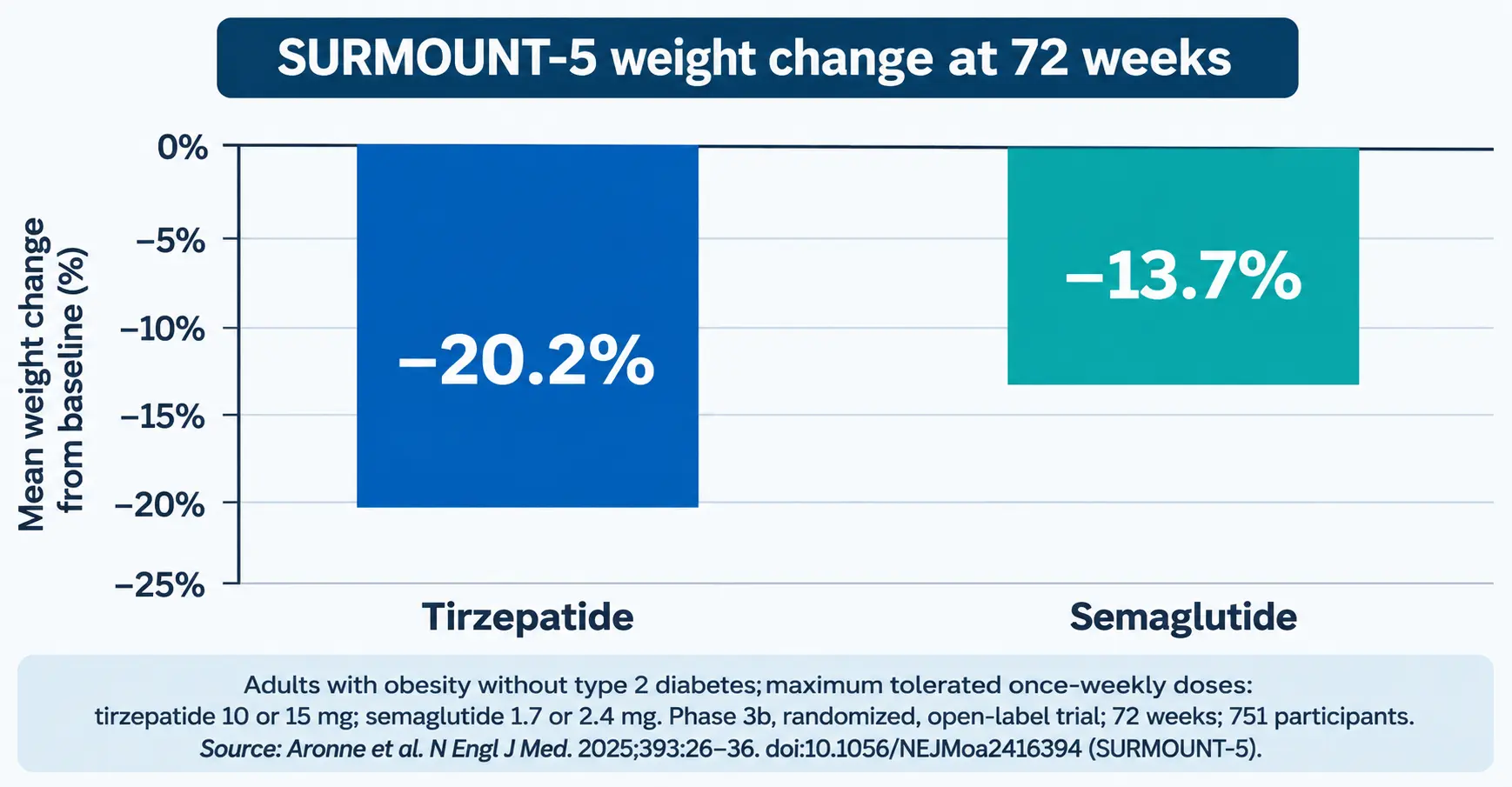
Tirzepatide produced more average weight loss than injectable semaglutide in SURMOUNT-5: 20.2% versus 13.7% at 72 weeks in adults with obesity and without diabetes, at the maximum tolerated doses studied. That does not make it universally better or safer. [1]
For blood sugar control, SURPASS-2 favored tirzepatide over semaglutide 1 mg, not over every semaglutide dose or formulation. Both drugs have common gastrointestinal side effects and a boxed thyroid C-cell tumor warning. Wegovy and Zepbound have weight-management indications; Ozempic and Mounjaro are not FDA-labeled for weight management. [2] [7]
Semaglutide vs. Tirzepatide: Quick Comparison
The brand-specific uses below summarize current labeling. On a narrow screen, scroll the table horizontally to read both medication columns. [7]
| Feature | Semaglutide | Tirzepatide |
|---|---|---|
| Active ingredient and class | Semaglutide; GLP-1 receptor agonist. | Tirzepatide; dual GIP and GLP-1 receptor agonist. |
| How it works | Acts on GLP-1 signaling involved in appetite and glucose regulation. | Acts on GIP and GLP-1 signaling involved in glucose regulation and appetite. |
| Brands discussed | Wegovy and Ozempic; oral semaglutide is also marketed as Rybelsus. | Zepbound and Mounjaro. |
| Weight-management uses | Wegovy: qualifying adults; injection also for patients aged 12 and older with obesity. Ozempic is not labeled for weight management. | Zepbound: qualifying adults. Mounjaro is not labeled for weight management. |
| Other approved uses | Wegovy: cardiovascular risk reduction in qualifying adults; injection also has an accelerated-approval MASH indication. Ozempic injection: type 2 diabetes, plus cardiovascular and kidney risk reduction in specified adult populations. | Zepbound: moderate-to-severe obstructive sleep apnea in adults with obesity. Mounjaro: type 2 diabetes in adults and patients aged 10 and older, plus cardiovascular risk reduction in qualifying adults. |
| Administration | Wegovy and Ozempic injections: weekly. Oral formulations: daily, with product-specific instructions. | Zepbound and Mounjaro: weekly injections. |
| Direct weight-loss evidence | SURMOUNT-5: mean weight reduction of 13.7% at 72 weeks. | SURMOUNT-5: mean weight reduction of 20.2% at 72 weeks. |
| Common side effects | Nausea, vomiting, diarrhea, constipation, abdominal pain. | Nausea, vomiting, diarrhea, constipation, abdominal pain. |
| Important safety considerations | Boxed thyroid C-cell tumor warning; pancreatitis, gallbladder disease, dehydration-related kidney injury, severe gastrointestinal effects, and other label precautions. | Same categories of concern; tirzepatide labels also give specific guidance for oral hormonal contraception. |
| Compounded versions | Not FDA-approved; not automatically equivalent to the approved product. | Not FDA-approved; not automatically equivalent to the approved product. |
SURMOUNT-5 used tirzepatide 10 or 15 mg and semaglutide 1.7 or 2.4 mg at maximum tolerated doses. It did not compare oral semaglutide or Wegovy HD 7.2 mg. [1]
What Is Semaglutide?
Semaglutide is a GLP-1 (glucagon-like peptide-1) receptor agonist. Its U.S. brands have different uses, and injection and tablet labels should not be merged. [7]
- Wegovy injection: long-term weight reduction in adults and patients aged 12 and older with obesity, and in adults with overweight plus at least one weight-related condition. It also reduces major cardiovascular event risk in adults with established cardiovascular disease and obesity or overweight.
- Wegovy injection and MASH: treatment of noncirrhotic metabolic dysfunction-associated steatohepatitis with moderate-to-advanced liver fibrosis (F2-F3) in adults. This is an accelerated approval based on improvement in MASH and fibrosis; continued approval may depend on confirmation of clinical benefit.
- Wegovy tablets: adult weight-management and cardiovascular risk-reduction indications in the specified populations; the tablet does not inherit the injection’s pediatric or MASH indication.
- Ozempic injection: blood sugar control in adults with type 2 diabetes; major cardiovascular event risk reduction in those with established cardiovascular disease; and reduction of sustained kidney function decline, end-stage kidney disease, and cardiovascular death in adults with type 2 diabetes and chronic kidney disease.
- Ozempic tablets and Rybelsus: daily oral semaglutide products for adult type 2 diabetes and major cardiovascular event risk reduction in adults with type 2 diabetes at high risk. They have separate dosing instructions and are not interchangeable milligram for milligram.
Ozempic is not FDA-labeled for weight management. A clinician may consider off-label prescribing in some circumstances, but that does not turn it into an approved weight-management indication. Insurance criteria can also differ by brand and diagnosis.
What Is Tirzepatide?
Tirzepatide is a dual GIP (glucose-dependent insulinotropic polypeptide) and GLP-1 receptor agonist. The two brands discussed here are once-weekly injections. [7]
- Zepbound: long-term weight reduction in adults with obesity, or overweight plus at least one weight-related condition; and treatment of moderate-to-severe obstructive sleep apnea in adults with obesity. Its label combines treatment with a reduced-calorie diet and increased physical activity.
- Mounjaro: blood sugar control in adults and pediatric patients aged 10 and older with type 2 diabetes, alongside diet and exercise. Its current label also includes reduction of major cardiovascular event risk in adults with type 2 diabetes at high risk for those events.
Mounjaro is not labeled for weight management. Zepbound does not have a pediatric indication in the label reviewed. Neither brand is simply a substitute for the other on the basis of the active ingredient alone.
How Semaglutide and Tirzepatide Work
GLP-1 and GIP are incretin hormones involved in the body’s response to eating. Both drugs stimulate insulin release in a glucose-dependent manner. Their effects also include changes in appetite, food intake, and gastric emptying. Semaglutide activates GLP-1 receptors; tirzepatide activates both GIP and GLP-1 receptors. [7]
Two receptors do not automatically mean a better medicine
The mechanism explains what the drug targets. It does not, by itself, establish that tirzepatide is safer, twice as effective, or right for every person. Trial results and a patient’s medical history are needed to judge benefits and risks.
These drugs do not “melt fat.” They affect biological pathways involved in appetite and glucose regulation. The weight-loss trials also included lifestyle support, so their results describe medication used within that treatment context.
How Do Semaglutide and Tirzepatide Compare for Weight Loss?
Direct comparison: SURMOUNT-5
SURMOUNT-5 enrolled 751 adults with obesity and without diabetes. Over 72 weeks, participants received the maximum tolerated dose of tirzepatide (10 or 15 mg) or semaglutide (1.7 or 2.4 mg). It was an open-label, randomized trial funded by Eli Lilly. [1]
- Tirzepatide: mean body weight reduction of 20.2%.
- Semaglutide: mean body weight reduction of 13.7%.
- Mean waist circumference decreased by 18.4 cm and 13.0 cm, respectively.
That supports greater average weight loss with tirzepatide under the conditions studied. It does not establish superiority for every patient, diabetes population, dose, formulation, or safety outcome. In particular, the comparator was not Wegovy HD 7.2 mg, which appears in the current Wegovy label. [7]
Indirect comparison: STEP 1 and SURMOUNT-1
These earlier trials are useful background, but they did not compare the two drugs with each other:
- STEP 1: 1,961 adults without diabetes; semaglutide 2.4 mg versus placebo for 68 weeks, with lifestyle intervention. Mean weight change was -14.9% versus -2.4%. [4]
- SURMOUNT-1: 2,539 adults without diabetes; tirzepatide 5, 10, or 15 mg versus placebo for 72 weeks. Mean weight change was -15.0%, -19.5%, and -20.9%, respectively, versus -3.1% with placebo. [3]
The populations, durations, and treatment arms differ. Putting these numbers side by side is not a substitute for a randomized head-to-head study. SURMOUNT-5 provides the direct weight-loss comparison discussed above.
Averages are not guarantees. Individual response, side effects, the ability to continue treatment, and access can substantially affect real-world results.
Which Medication Is More Effective for Blood Sugar Control?
SURPASS-2 directly compared tirzepatide with semaglutide in 1,879 adults with type 2 diabetes inadequately controlled on metformin. The open-label trial lasted 40 weeks; mean baseline HbA1c was 8.28%. HbA1c reflects blood sugar exposure over roughly the preceding few months. [2]
| Weekly treatment studied | Mean HbA1c change |
|---|---|
| Semaglutide 1 mg | -1.86 percentage points |
| Tirzepatide 5 mg | -2.01 percentage points |
| Tirzepatide 10 mg | -2.24 percentage points |
| Tirzepatide 15 mg | -2.30 percentage points |
Tirzepatide met the trial’s noninferiority and superiority criteria at all three doses. However, this was a comparison with semaglutide 1 mg, not Ozempic injection’s 2 mg maximum or every oral formulation. These diabetes results should not be presented as a weight-loss trial in people without diabetes.
Both ingredients can improve glucose regulation. Cardiovascular, kidney, liver, or sleep-apnea benefits require their own product-specific evidence and indications; a larger HbA1c reduction alone does not establish greater benefit for all metabolic outcomes. [7]
Side Effects and Safety: Semaglutide vs. Tirzepatide
Common gastrointestinal effects
Nausea, vomiting, diarrhea, constipation, and abdominal pain are common with both ingredients. Symptoms often occur during treatment initiation or dose escalation. Some people experience substantial symptoms or discontinue treatment. The fact that tirzepatide produced more weight loss in a trial does not establish better tolerability. [7]
Boxed thyroid C-cell tumor warning
The products reviewed carry a boxed warning because semaglutide and tirzepatide caused thyroid C-cell tumors in rodents. It is unknown whether they cause these tumors, including medullary thyroid carcinoma, in humans. They are contraindicated in people with a personal or family history of medullary thyroid carcinoma or multiple endocrine neoplasia syndrome type 2 (MEN 2). This is not a statement that every thyroid condition is a contraindication. [7]
Other warnings and precautions
- Pancreatitis and gallbladder disease: severe, persistent abdominal pain warrants prompt medical evaluation.
- Dehydration and kidney injury: repeated vomiting or diarrhea can lead to fluid loss and acute kidney injury.
- Severe gastrointestinal reactions: the reviewed labels do not recommend these products in severe gastroparesis.
- Hypoglycemia: risk increases with insulin or an insulin secretagogue, such as a sulfonylurea. A prescriber may need to adjust the other medication.
- Allergic reactions: anaphylaxis and angioedema have been reported.
- Diabetic retinopathy: existing diabetic eye disease may require monitoring.
- Anesthesia and sedation: delayed gastric emptying is associated with reported pulmonary aspiration. Tell the procedural team about treatment; do not invent your own medication-holding schedule.
- Product-specific precautions: Wegovy also includes heart-rate monitoring. Consult the individual label rather than treating this summary as a complete list.
Never share a single-patient-use injection pen, even if its needle is changed. Product devices and instructions differ. [7]
When to seek help
Seek emergency help for trouble breathing, swelling of the face or throat, or other signs of a severe allergic reaction. Contact a healthcare professional promptly for severe or persistent abdominal pain, inability to keep fluids down, vision changes, or a neck lump, persistent hoarseness, or trouble swallowing. Do not assume that a new or severe symptom is merely an expected side effect.
Contraindications, Pregnancy, and Contraception
Beyond the thyroid-related contraindications, the labels prohibit use in people with the specified hypersensitivity to the active ingredient or formulation components. A history of pancreatitis, gallbladder disease, kidney problems, diabetic eye disease, significant gastrointestinal symptoms, and other medications calls for individual evaluation. [7]
Pregnancy and breastfeeding
For weight management, these treatments are not appropriate during pregnancy. The Wegovy weight-management label directs discontinuation when pregnancy is recognized and at least two months before a planned pregnancy; Ozempic also specifies at least two months before a planned pregnancy. Zepbound directs discontinuation when pregnancy is recognized. Mounjaro warns of potential fetal harm based on animal studies. These are label statements to discuss with a prescriber, not a personalized stopping plan. [7]
Wegovy’s MASH indication has different pregnancy risk-benefit wording, so a blanket statement covering every indication would be misleading. Breastfeeding guidance also varies by formulation; the reviewed Wegovy label does not recommend breastfeeding during tablet treatment. Discuss pregnancy plans and breastfeeding before starting or changing therapy.
Tirzepatide and oral hormonal contraception
Zepbound and Mounjaro labels advise people using oral hormonal contraceptives to switch to a non-oral method or add a barrier method for four weeks after starting treatment and four weeks after each dose increase. Delayed gastric emptying may affect oral contraceptive efficacy. Do not automatically apply this tirzepatide-specific instruction to semaglutide; a clinician or pharmacist should review the exact medication and any vomiting or diarrhea that might affect oral medicines. [7]
Dosage and How the Treatments Are Taken
Wegovy and Ozempic injections, Zepbound, and Mounjaro are generally administered once weekly. Treatment starts at a lower dose and increases gradually to help reduce gastrointestinal reactions. The exact schedule depends on the brand, indication, response, and tolerability. [7]
- Semaglutide injections: labeling begins at 0.25 mg weekly, with staged escalation. Ozempic and Wegovy have different maintenance regimens.
- Tirzepatide injections: labeling begins at 2.5 mg weekly, with increases in 2.5 mg increments after at least four weeks on the current dose, as directed by the product-specific schedule.
- Oral semaglutide: daily tablets have separate escalation and empty-stomach administration instructions. Tablet and injection doses are not interchangeable milligram for milligram.
The current Wegovy label includes a higher-dose 7.2 mg presentation (Wegovy HD), while its usual recommended injection maintenance dose is 2.4 mg. That higher dose was not used in SURMOUNT-5. Maintenance doses also differ by indication, and Mounjaro’s pediatric maximum differs from its adult maximum. This is why a generic internet dosing chart cannot replace the actual prescription and label.
Ask the prescriber or pharmacist about device training, storage, missed doses, and symptoms during escalation. Do not accelerate the schedule, substitute another product, or calculate a compounded dose from a brand-name pen’s instructions.
What Happens When Treatment Stops?
Randomized withdrawal trials show that weight regain is common after medication is withdrawn, even when lifestyle intervention continues. These studies compare continuing one drug with switching to placebo, not semaglutide directly with tirzepatide.
- SURMOUNT-4: after 36 weeks of tirzepatide treatment, participants were randomized to continue it or switch to placebo. From weeks 36 to 88, mean weight change was -5.5% with continued treatment versus +14.0% with placebo. [5]
- STEP 4: after a 20-week semaglutide run-in, participants continued semaglutide or switched to placebo. From weeks 20 to 68, mean weight change was -7.9% versus +6.9%. [6]
These percentages are measured from the point of randomization, not from the original pretreatment weight. Different run-in periods and selected trial participants mean they should not be used to rank the drugs’ “rebound” effects. They support planning for long-term treatment and follow-up rather than assuming that weight loss will persist unchanged after stopping.
People treated for diabetes also need a plan for blood sugar monitoring and alternative therapy if appropriate. Any change should be coordinated with the treating clinician.
Where Lifestyle Fits
Medication does not replace nutrition, physical activity, or ongoing care. STEP 1 and SURMOUNT-1 included lifestyle intervention, and the weight-management labels describe treatment alongside a reduced-calorie diet and increased physical activity. Discuss sustainable eating patterns, adequate nutrition, activity, and any persistent eating difficulties with a clinician or dietitian. [4] [3]

Cost Comparison: Semaglutide vs. Tirzepatide
There is no single price for either ingredient. The total depends on the brand, formulation, dose, pharmacy, insurance benefit, deductible, eligibility for a manufacturer offer, and any separate consultation or subscription fees. A list price, an introductory cash-pay offer, and an insured copayment are different measures.
Dated example: Wegovy self-pay offers
The manufacturer’s pricing page, checked November 12, 2026, listed the following. These are examples of a specific savings channel, not a guarantee of what a reader will pay. [10]
- Wegovy tablets: $149 per month at 1.5 mg, $199 at 4 mg, and $299 at 9 or 25 mg. A month is defined as 30 tablets.
- Wegovy injection: eligible new participants in the savings offer or NovoCare pay $199 for each of two monthly fills at 0.25 or 0.5 mg through December 31, 2026; then $349 per month for the listed doses through 2.4 mg.
- Wegovy HD 7.2 mg: the page lists $399 per month. A month of injections is defined as a box of four pens.
Eligibility and restrictions apply, and the manufacturer reserves the right to change or cancel the offers. The introductory dose price should not be mistaken for the ongoing maintenance cost.
This article does not quote an unverified current price for Ozempic, Zepbound, or Mounjaro or claim that one is universally cheaper. Obtain a current quote for the prescribed dose and ask what recurring service fees are separate from the medicine.
Insurance, savings, and availability
Coverage depends on the plan and the product’s indication. Approval for a medical use does not guarantee that an insurer covers it. Prior authorization and other plan requirements may apply. Manufacturer savings programs have their own eligibility restrictions; government-program beneficiaries may be excluded from commercial savings offers, as they are in the Wegovy commercial offer described on the source page. [10]
Medicare coverage and special access programs require a separate eligibility check. Do not assume that an advertised copayment applies to everyone. A pharmacist or insurer can confirm the current rules for the exact product and indication.
National shortage resolution does not guarantee immediate stock at every local pharmacy. Check the specific formulation and dose before committing to a treatment or subscription plan. [9]
Why compounded pricing is not an equivalent comparison
An advertised compounded-drug subscription may include a different concentration, formulation, quantity, or service package. A lower quote does not establish equivalence to a branded medicine or that the preparation meets current compounding requirements. Consider medication, consultation, shipping, cancellation terms, and follow-up together, without treating price as evidence of safety.
FDA-Approved vs. Compounded Semaglutide and Tirzepatide
FDA-approved products undergo agency review for safety, effectiveness, and manufacturing quality. Compounded preparations are not FDA-approved; FDA does not review them for safety, effectiveness, or quality before marketing. They should not be described as “FDA-approved compounded semaglutide” or assumed equivalent to a branded product. [8]
FDA recommends compounded drugs only when an approved drug cannot meet a patient’s medical need. It advises obtaining a prescription from a doctor and filling it at a state-licensed pharmacy. State licensing is important, but it does not mean that a compounded product itself has FDA approval.
Current shortage and compounding context
FDA’s policy page records the tirzepatide injection shortage as resolved on December 19, 2024, and the semaglutide injection shortage as resolved on February 21, 2025. Its April 1, 2026 clarification states that neither substance is currently on the 503B bulks list or FDA shortage list. The shortage-related transition periods described on that page have ended. [9]
- Section 503A: compounding is for an identified patient based on a prescription, with restrictions on regularly or inordinate amounts making products that are essentially copies of commercially available drugs. A prescriber-documented change producing a significant difference for an individual patient is relevant to the FDA’s copy analysis.
- Section 503B: outsourcing facilities’ use of bulk drug substances is restricted to the applicable bulks-list or shortage-list conditions. A claim that compounding is unrestricted merely because a pharmacy is registered or licensed is misleading.
- Added ingredients: adding vitamin B12 does not automatically avoid FDA’s “essentially a copy” assessment.
This is a summary of FDA guidance, not a legal finding about any particular pharmacy or provider. Check the current FDA page and discuss the clinical need and dispensing pharmacy with the prescriber.
Specific quality and dosing concerns
FDA describes dosing errors, adverse events, inadequate refrigeration during shipping, and fraudulent labels. Semaglutide sodium and semaglutide acetate are different active ingredients from the one in approved drugs; FDA states that it is not aware of a lawful basis for their use in compounding. Approved-product trial averages do not establish the results of these preparations. [8]
How to Choose Between Semaglutide and Tirzepatide With a Clinician
The useful question is not simply which drug has the larger trial percentage. A qualified healthcare professional may weigh:
- Treatment goals and diagnosis: weight management, type 2 diabetes, or a separately approved cardiovascular, kidney, liver, or sleep-apnea indication.
- Medical history: contraindications, previous reactions, gastrointestinal conditions, eye disease, and pregnancy or breastfeeding plans.
- Other medications: insulin, sulfonylureas, oral contraceptives, and medicines whose absorption or monitoring may be affected.
- Tolerability and preferences: symptoms during escalation, device use, daily tablet instructions, and the practicality of ongoing care.
- Access: insurance approval, recurring costs, local availability, and reliable follow-up.
A larger average effect can matter, but so can an indication supported by specific outcome evidence or a product a patient can tolerate and consistently obtain. This article cannot choose a medication for an individual reader.
Frequently Asked Questions
“Stronger” is imprecise. Tirzepatide produced larger average weight and HbA1c changes in the direct trials discussed here, at the comparator doses studied. That is not proof of greater safety, universal suitability, or potency per milligram; the drugs use different dose scales. [1] [2]
In SURMOUNT-5, tirzepatide produced a mean 20.2% weight reduction versus 13.7% with injectable semaglutide over 72 weeks in adults with obesity and without diabetes. Individual results vary, and this was not a comparison with oral semaglutide or Wegovy HD. [1]
They are related incretin-based drugs, but not identical. Semaglutide is a GLP-1 receptor agonist; tirzepatide is a dual GIP and GLP-1 receptor agonist. Their brands, indications, formulations, and doses differ. [7]
A prescriber can change treatment when appropriate, but the timing, dose, and monitoring require a clinical plan. There is no simple milligram-for-milligram conversion. Do not overlap prescriptions or improvise a switching schedule.
Yes. The approved products discussed here are prescription medicines. Legitimate compounding also operates within prescription and legal requirements; an online offer without appropriate clinical screening is a warning sign. [8] [9]
The Wegovy and Zepbound labels do not recommend combining them with other GLP-1 receptor agonists; Zepbound also does not recommend another tirzepatide-containing product. Taking semaglutide and tirzepatide together is not an established weight-management regimen. Do not combine them or overlap them during a switch without a prescriber’s treatment plan. [7]
Weight regain occurred on average after withdrawal in SURMOUNT-4 and STEP 4. Those studies do not predict every person’s response or provide a direct comparison of rebound between drugs. Discuss follow-up, weight maintenance, and blood sugar management where relevant before changing treatment. [5] [6]
Final Thoughts
Semaglutide and tirzepatide share important benefits and risks but are distinct medications. Tirzepatide produced greater average weight loss in SURMOUNT-5 and greater HbA1c reductions than semaglutide 1 mg in SURPASS-2. Those findings must be read within the populations and doses studied, not as a universal ranking.
The appropriate brand and formulation depend on medical history, treatment goals, tolerability, contraindications, and access. Compounded preparations do not inherit FDA approval or the evidence of approved products. For a broader explanation of the treatment landscape, read our GLP-1 guide to benefits, risks, and medical weight loss.
📚 Related Articles
Explore more evidence-based guides, supplement reviews, and practical wellness articles to better understand ingredients, benefits, limitations, and how different products compare.
- ➡️ Medical Weight Loss: Understanding GLP-1 Treatments, Benefits and Risks
- ➡️ Compounded Semaglutide vs. FDA-Approved Semaglutide: Key Differences, Safety & What to Know
- ➡️ HealSend Review: GLP-1 Treatments, Costs, Benefits & Potential Risks
- ➡️ How Much Do GLP-1 Treatments Cost?
- ➡️ Healthy Weight Benefits: Physical & Mental Health Impact
- ➡️ NR vs NMN vs NAD+: Key Differences, Benefits, and What Research Shows
- ➡️ What Is NAD+? Benefits, Functions & What the Science Says
- ➡️ Genuine Purity Longevity+ Review
- ➡️ Genuine Purity NMN Trial Review
- ➡️ Healthy Aging Supplements Explained
- ➡️ What Is Berberine? Benefits, Uses, Side Effects & How It Works
- ➡️ Berberine Benefits for Blood Sugar and Metabolic Health
- ➡️ Hydration Benefits: Health Tips for Daily Water Intake
- ➡️ How to Support Healthy Blood Sugar Levels Naturally
- ➡️ The Importance of Quality Sleep for a Healthier Life
- ➡️ The Benefits of Magnesium for Sleep and Stress
- ➡️ Revive Daily Review
- ➡️ Java Burn Review: Ingredients, Benefits, Pros & Cons
Sources
Sources checked November 12, 2026. Prescribing information, prices, availability, and regulatory policies can change. Trial percentages refer to selected study populations, not guaranteed individual outcomes.
- Aronne LJ, et al. Tirzepatide as Compared with Semaglutide for the Treatment of Obesity (SURMOUNT-5). N Engl J Med. 2025;393:26-36. doi:10.1056/NEJMoa2416394.
- Frias JP, et al. Tirzepatide versus Semaglutide Once Weekly in Patients with Type 2 Diabetes (SURPASS-2). N Engl J Med. 2021;385:503-515. doi:10.1056/NEJMoa2107519.
- Jastreboff AM, et al. Tirzepatide Once Weekly for the Treatment of Obesity (SURMOUNT-1). N Engl J Med. 2022;387:205-216. doi:10.1056/NEJMoa2206038.
- Wilding JPH, et al. Once-Weekly Semaglutide in Adults with Overweight or Obesity (STEP 1). N Engl J Med. 2021;384:989-1002. doi:10.1056/NEJMoa2032183.
- Aronne LJ, et al. Continued Treatment With Tirzepatide for Maintenance of Weight Reduction in Adults With Obesity (SURMOUNT-4). JAMA. 2024;331:38-48. doi:10.1001/jama.2023.24945.
- Rubino D, et al. Effect of Continued Weekly Subcutaneous Semaglutide vs Placebo on Weight Loss Maintenance in Adults With Overweight or Obesity (STEP 4). JAMA. 2021;325:1414-1425. doi:10.1001/jama.2021.3224.
- National Library of Medicine. DailyMed product-specific prescribing information: Wegovy injection and tablets; Ozempic injection; Ozempic tablets and Rybelsus; Zepbound; Mounjaro.
- U.S. Food and Drug Administration. FDA’s Concerns with Unapproved GLP-1 Drugs Used for Weight Loss. Page current as of October 1, 2026.
- U.S. Food and Drug Administration. FDA clarifies policies for compounders as national GLP-1 supply begins to stabilize. Includes April 1, 2026 clarification and earlier shortage-resolution decisions.
- Novo Nordisk. Wegovy cost and savings options. Manufacturer-listed terms checked November 12, 2026; eligibility restrictions apply and offers may change.