Author: VitaWeller Health & Wellness Editorial Team
Evidence Reviewed: Peer-reviewed studies, systematic reviews, and guidance from recognized health organizations (NIH, NCCIH, ADA, Mayo Clinic).
Editorial Standards: Evidence-based • Independently researched • Fact-checked before publication
Introduction
NR, NMN, and NAD+ tend to get bundled together in supplement content, almost as if they were three versions of the same thing. That is part of why this topic gets confusing so quickly. The names are related, but they do not mean the same thing, and the evidence behind them is not interchangeable either.
A useful starting point is simple: NAD+ is the molecule cells use, while NR and NMN are compounds involved in making more of it. The trouble begins when those basic facts get stretched into bigger claims about energy, aging, or performance without keeping mechanism, supplement theory, and human outcomes separate. If you want a broader foundation first, our NAD+ explainer covers the basic biology in more detail.
This article takes that apart step by step. It looks at what each compound is, how it fits into the broader NAD+ discussion, and where the human evidence is reasonably solid versus where it is still thin. That is usually more helpful than asking which label sounds most impressive.
Evidence Review
Evidence Level: ★★★☆☆ Moderate Evidence
- 🧬 NAD+ itself is not speculative. Its role in energy metabolism, cellular repair, and stress-response pathways is well established.
- 📚 From a supplement perspective, the human literature is still more developed for NR and increasingly active for NMN than it is for direct oral NAD+ products.
- ⚠️ The clearest findings still tend to involve biomarkers, especially NAD+ related measures in blood, rather than stronger clinical outcome data.
- ⚖️ Claims about anti-aging, major energy changes, or broad health transformation usually go further than the current human evidence can comfortably support.
Put simply, the biology is interesting, but the supplement claims are often more confident than the research really allows.
Quick Answer
NR and NMN are not substitutes for NAD+ in the strict sense. They are precursor compounds involved in pathways that help the body make it. NAD+ is the molecule cells actually rely on. In terms of human supplement evidence, NR is still the most established category, NMN is developing, and direct oral NAD+ is the area where the claims tend to run furthest ahead of the data.
There is no clean winner that makes sense in every context. The answer shifts depending on whether you care most about basic biology, supplement evidence, or likely real-world usefulness.
Table of Contents
- What Are NR, NMN, and NAD+?
- NR vs NMN vs NAD+: What Is the Main Difference?
- How the NAD+ Pathway Works in the Body
- NR vs NMN vs NAD+: Quick Comparison
- Why People Compare These Compounds
- What Research Says About NR
- What Research Says About NMN
- What Research Says About Direct NAD+
- Bioavailability and Absorption Questions
- Which Has the Strongest Human Evidence?
- How to Evaluate NAD+ Supplement Claims
- Frequently Asked Questions
- Scientific References
What Are NR, NMN, and NAD+?
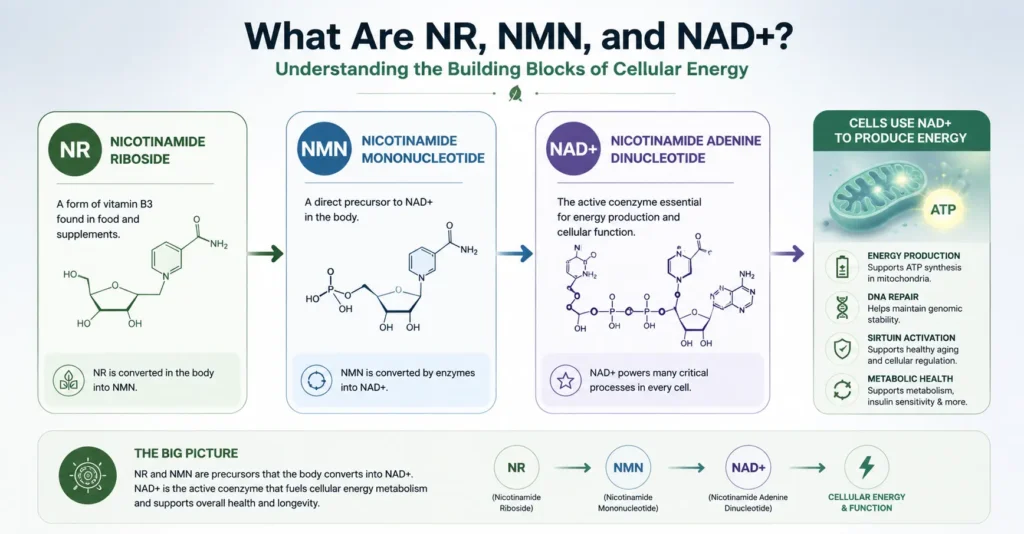
NAD+ stands for nicotinamide adenine dinucleotide. It is a coenzyme involved in energy production and a range of cellular processes tied to repair, signaling, and metabolic function. In plain language, it is not just another wellness buzzword. It is a real molecule with a real role in biology.
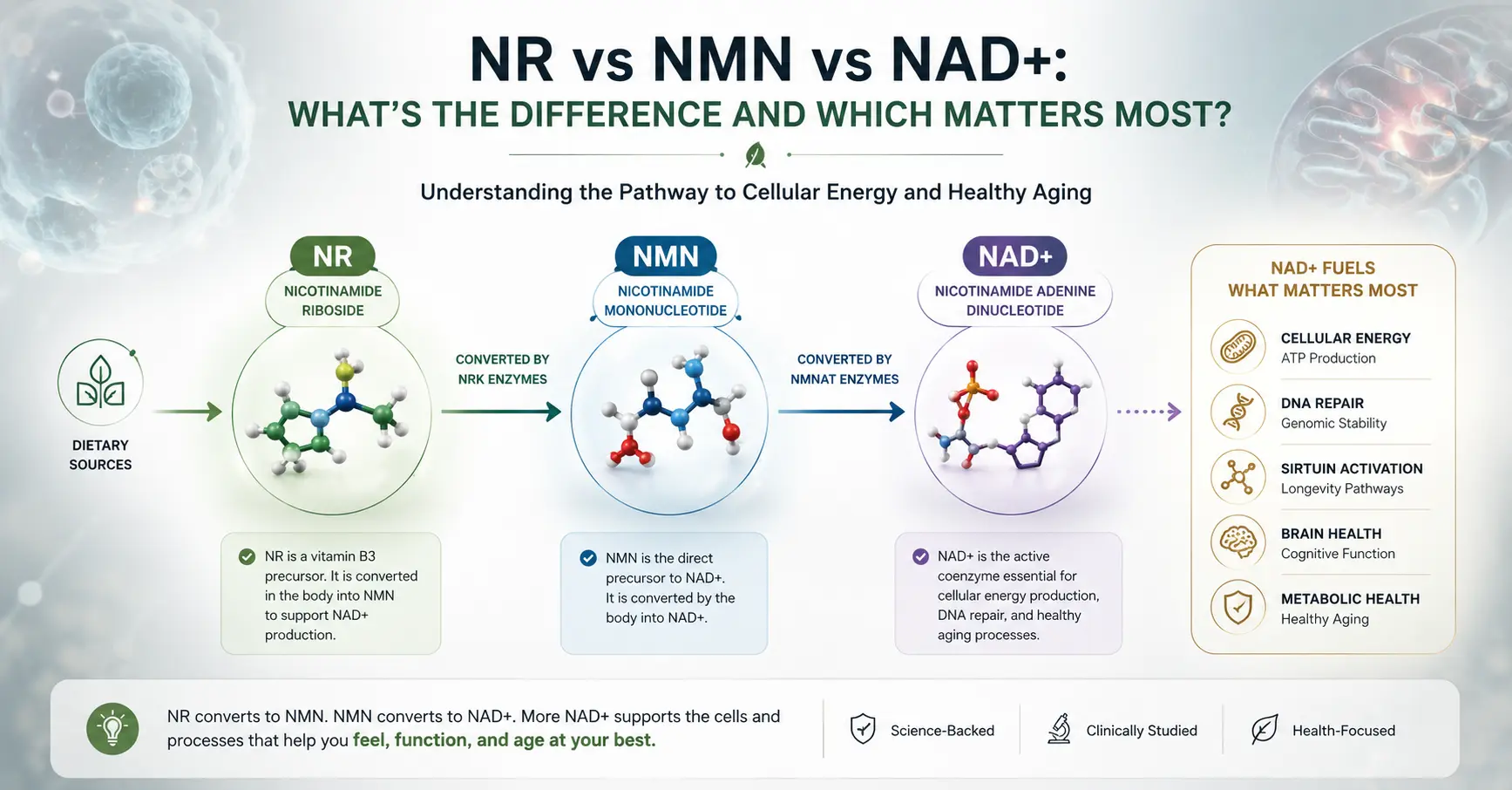
NR, short for nicotinamide riboside, and NMN, short for nicotinamide mononucleotide, are not the same thing as NAD+. They are precursors, meaning the body can use them in pathways that contribute to NAD+ production. That is why they show up so often in supplement formulas.
This difference may sound technical, but it changes how the evidence should be read. A useful result for an NR supplement does not prove the same outcome for NMN. Likewise, the fact that NAD+ is essential inside the body does not automatically validate every oral product that puts NAD+ on the label.
NR vs NMN vs NAD+: What Is the Main Difference?
The clearest distinction is that NAD+ is the active coenzyme, while NR and NMN are upstream compounds involved in producing it. That may sound like a technical detail, but it changes how a comparison should be read. Cells use NAD+ directly. NR and NMN first have to move through metabolic pathways before they contribute to the same pool.
The confusion usually comes from treating two different claims as if they were one. A compound can be relevant to NAD+ metabolism without it being clearly proven to improve energy, cognition, or healthy aging in a meaningful everyday sense. The first point is easier to support than the second.
So when someone asks which one is better, the honest answer usually starts with another question: better for what, and supported by what kind of evidence?
How the NAD+ Pathway Works in the Body
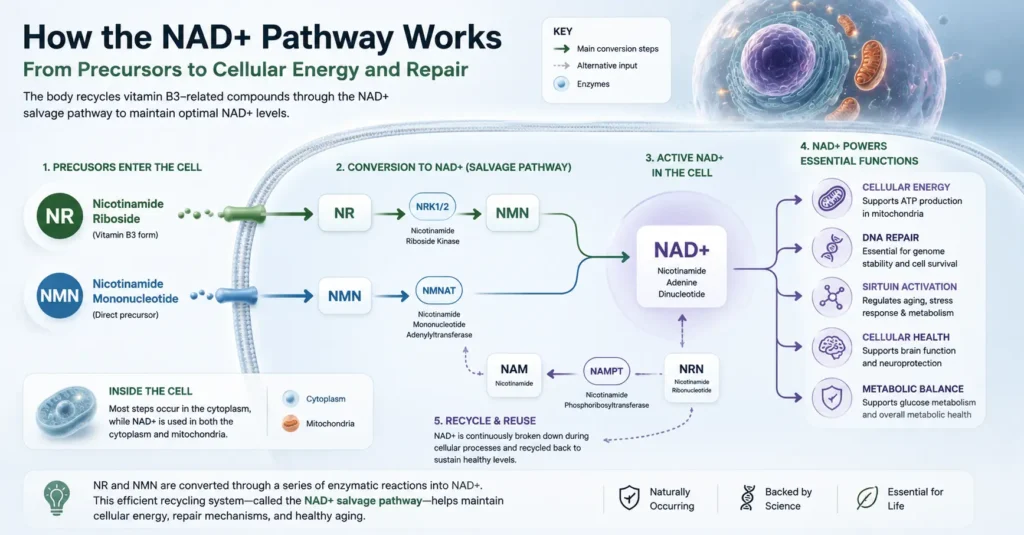
The body maintains NAD+ through more than one route. It can produce and recycle it through several pathways, including salvage pathways that reuse related compounds. NR and NMN matter because they feed into that larger system rather than operating as standalone magic bullets.
That helps explain why the category keeps attracting so much attention. NAD+ biology is relevant to metabolism, stress response, and aging research, so it makes sense that scientists keep studying compounds linked to it. Still, biological relevance is not the same thing as strong proof for a supplement benefit.
Why Precursors Get More Attention Than Direct NAD+
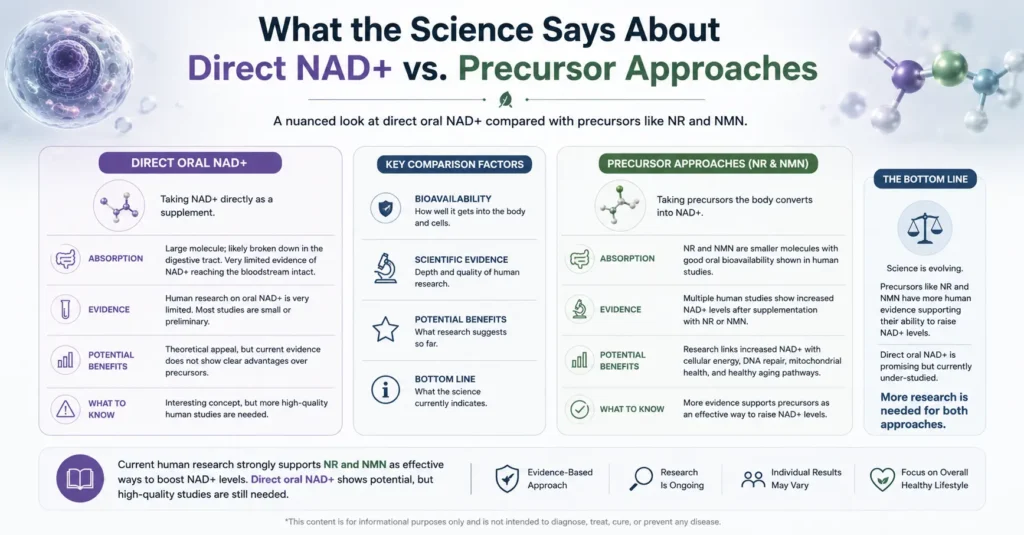
Direct NAD+ sounds intuitive on first pass, but the more developed supplement literature has focused on precursors. In practice, researchers have had an easier time building evidence around NR and NMN than around strong claims for oral NAD+ itself.
NR vs NMN vs NAD+: Quick Comparison
| Compound | What it is | Main role in the discussion | Current evidence pattern |
|---|---|---|---|
| NR | Nicotinamide riboside | NAD+ precursor used in supplement research | Best developed human literature of the three categories |
| NMN | Nicotinamide mononucleotide | NAD+ precursor with growing research interest | Promising but still less mature than NR in humans |
| NAD+ | The coenzyme cells actually use | The biological target people want to support | Essential in biology, but less persuasive as an oral supplement category |
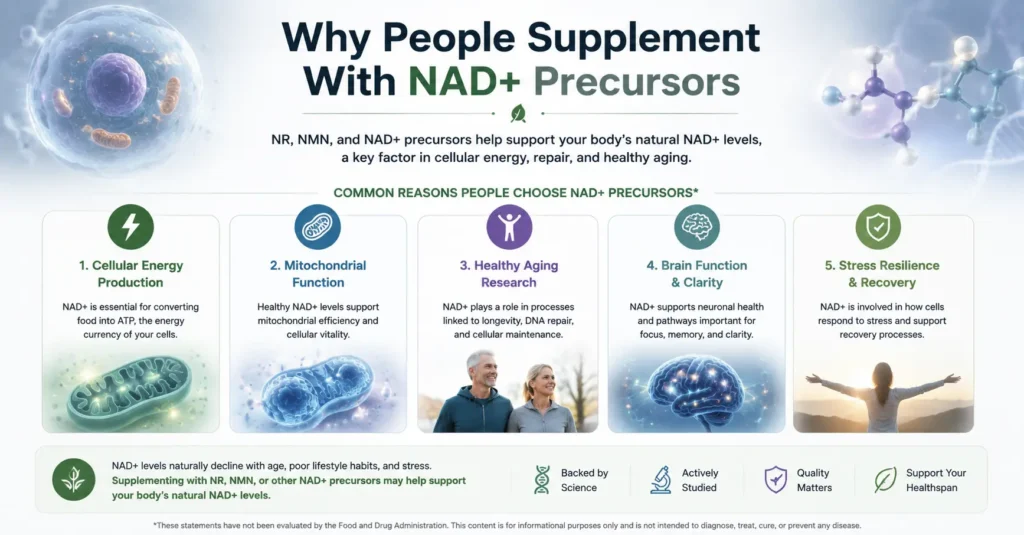
Why People Compare These Compounds
Most people do not end up here because they want a lesson in cellular metabolism. They are usually trying to sort out a practical question: if these compounds are all tied to NAD+, does one of them look more believable for energy, healthy aging, or metabolic support?
That is also where the topic gets messy. Once a molecule is linked to mitochondrial function or age-related decline, it becomes very easy to market. What is harder, and much more important, is figuring out whether a supplement does more than shift a biomarker and whether those shifts translate into something meaningful for actual people.
The useful way to compare them is to keep those layers separate. Mechanism matters, and early biomarker findings matter too, but neither one settles the larger question of long-term benefit on its own.
What Research Says About NR
NR is usually the easiest place to start because it has the longest and clearest human supplement track record in this category. Multiple human studies suggest that oral NR can raise NAD+ related biomarkers in blood, which gives the discussion a firmer footing than pure theory.
The harder question is what to do with that result. A biomarker moving in the expected direction is encouraging, but it still leaves plenty of room between “this pathway responds” and “people noticeably function better over time.” That gap is where much of the sales language gets ahead of the evidence.
So the fair summary on NR is not that it is fully proven, and not that it is all hype. It is that NR has one of the more credible human evidence bases in the NAD+ supplement space, while still leaving major practical questions unresolved.
Biomarker evidence is useful, but it is not the whole story
Biomarkers often give the first sign that an intervention is doing something measurable. That is valuable. It is just not the same as showing that people feel better, perform better, or see durable health benefits.
What Research Says About NMN
NMN gets a lot of attention for understandable reasons. It sits close to NAD+ in the pathway, it fits neatly into the broader longevity narrative, and it has become one of the more recognizable names in the category. Human research has grown in recent years, with some studies reporting encouraging signals in areas like metabolic function or muscle related outcomes in selected populations.
Even so, the NMN story still feels early compared with the confidence of the marketing around it. The published work is promising enough to take seriously, but not strong enough to flatten every product into the same claim. Dose, formulation, study design, and the population being studied all change how much weight a result should carry.
The fairest read is that NMN is worth taking seriously, but it is still a category where the excitement tends to move faster than the evidence.
What Research Says About Direct NAD+
Direct oral NAD+ has obvious appeal on paper. If NAD+ is the molecule the body uses, it sounds intuitive to assume that taking NAD+ itself should be the most direct route. That is also why product positioning in this category can sound especially persuasive.
The difficulty is that the evidence is not nearly as simple as the branding makes it sound. What happens to oral NAD+ after ingestion is more complicated than “take it and cells use it.” Digestion, metabolism, transport, and tissue handling all affect the outcome, which is why simple winner-style claims rarely hold up well.
That does not mean direct NAD+ products should be dismissed outright. It does mean they deserve a more skeptical reading than their branding usually invites. At this stage, confidence should come from product specific evidence, not from the prestige of the molecule name alone.
Bioavailability and Absorption Questions
One of the easiest mistakes in this category is assuming the molecule that sounds most direct must also be the best absorbed or most effective. Biology rarely works that neatly. Absorption and usefulness depend on more than a label name.
This is also why product comparisons can become misleading very quickly. If a brand focuses only on pathway diagrams or simplified rankings, it can make a complicated research area look far more settled than it is.
What to keep in mind when brands talk about absorption
- Different molecules can be processed differently after ingestion.
- Changes in blood biomarkers do not automatically predict long-term outcomes.
- Dose, formulation quality, and study design matter as much as ingredient identity.
- Human trials carry more weight than mechanistic storytelling alone.
Which Has the Strongest Human Evidence?
If the question is which molecule matters most inside the body, NAD+ is the obvious answer because it is the one cells actually use.
If the question is which supplement category currently looks best supported in humans, NR still comes out ahead. NMN follows with growing interest and some encouraging findings, while direct oral NAD+ remains the least convincing area from a research perspective.
That ranking is only about the current state of the human evidence. It is not a verdict on which molecule sounds most advanced or has the most interesting biology behind it.
How to Evaluate NAD+ Supplement Claims
The best way to read this category is to slow down and identify what is actually being claimed. Some brands are describing a plausible pathway. Others are implying a measurable life improvement. Those are very different statements.
- Is the claim supported by human studies, or mainly by theory and preclinical work?
- Does the evidence show biomarker changes, symptom changes, or meaningful functional outcomes?
- Is the advertised dose similar to the dose studied in humans?
- Are the claims careful and specific, or broad enough to sound impressive without saying much?
- Is the cited evidence about the exact product, or only about a loosely related ingredient category?
Evidence quality matters more than label drama
In this category, a calm product with transparent dosing and realistic claims is often more credible than a flashy formula promising a major anti-aging upgrade.
Frequently Asked Questions
NR usually looks better supported at this point because the human supplement literature is more developed. NMN is still a serious and interesting category, but the evidence base is not as mature yet.
In biological terms, yes. NAD+ is the active coenzyme the body uses. That said, this does not automatically make oral NAD+ the best supported supplement category.
Human studies suggest they can raise NAD+ related biomarkers, especially in blood. What those shifts mean for energy, performance, or longer-term health outcomes is still a more limited question.
Current evidence does not support that kind of promise. The aging research is active and worth watching, but the jump from mechanism to a dramatic anti-aging claim is still much bigger than marketing language usually makes it sound.
Look at the dose, the exact form being used, the kind of evidence being cited, and whether the marketing language stays reasonably close to what the data actually supports.
📚 Related Articles
Explore more evidence-based guides, supplement reviews, and practical wellness articles to better understand ingredients, benefits, limitations, and how different products compare.
- ➡️ What Is NAD+? Benefits, Functions & What the Science Says
- ➡️ Jeemya NAD+ Review: Ingredients, Benefits, Dosage & Is It Worth It?
- ➡️ Genuine Purity Longevity+ Review
- ➡️ Healthy Aging Supplements Explained
- ➡️ What Is Berberine? Benefits, Uses, Side Effects & How It Works
- ➡️ Healthy Weight Benefits: Physical & Mental Health Impact
- ➡️ Berberine Benefits for Blood Sugar and Metabolic Health
- ➡️ Jeemya Berberine HCl 800mg Review
- ➡️ Hydration Benefits: Health Tips for Daily Water Intake
- ➡️ How to Support Healthy Blood Sugar Levels Naturally
- ➡️ The Importance of Quality Sleep for a Healthier Life
- ➡️ The Benefits of Magnesium for Sleep and Stress
- ➡️ Revive Daily Review
- ➡️ Java Burn Review: Ingredients, Benefits, Pros & Cons
Scientific References & Trusted Resources
The following sources provide background on NAD+ metabolism, aging biology, and clinical research on NAD+-related supplementation.
- Covarrubias AJ, Perrone R, Grozio A, Verdin E. NAD+ metabolism and its roles in cellular processes during ageing. Nature Reviews Molecular Cell Biology. 2021.
- Rajman L, Chwalek K, Sinclair DA. Therapeutic Potential of NAD-Boosting Molecules. Cell Metabolism. 2018.
- Martens CR, et al. Chronic nicotinamide riboside supplementation is well-tolerated and elevates NAD+ in healthy middle-aged and older adults. Nature Communications. 2018.
- Airhart SE, et al. An open-label, non-randomized study of the pharmacokinetics of nicotinamide riboside and its effects on blood NAD+ levels in healthy volunteers. PLOS ONE. 2017.
- Experimental Gerontology review literature on age-related NAD+ decline in humans.
- PubMed search for human NR and NAD+ studies.
- NIH Office of Dietary Supplements.