
Author: VitaWeller Health & Wellness Editorial Team
Evidence Reviewed: Peer-reviewed studies, systematic reviews, and guidance from recognized health organizations (NIH, NCCIH, ADA, Mayo Clinic).
Editorial Standards: Evidence-based • Independently researched • Fact-checked before publication
Introduction
Semaglutide is the active ingredient in prescription medicines, but the shared name does not make compounded products the same as FDA-approved Wegovy, Ozempic, or Rybelsus. Approved medicines are reviewed for specific uses and manufacturing quality; compounded drugs are not FDA-approved. Here is what that difference means for evidence, safety, and current compounding rules in this comparison of compounded vs FDA-approved semaglutide.
Quick Answer
Compounded semaglutide is not FDA-approved or a generic version of Wegovy or Ozempic. It has not received the FDA review applied to approved drugs. Compounding may meet a specific patient need when legal requirements are met, but it does not establish equivalence. Approved semaglutide products also differ by brand, form, dose, and labeled use.
FDA-Approved Semaglutide: Brands, Forms, and Uses
Semaglutide is a glucagon-like peptide-1 (GLP-1) receptor agonist. It acts on the GLP-1 receptor, affecting processes such as glucose regulation, appetite, and digestion. It is not the same drug class as tirzepatide, which acts on both GIP and GLP-1 receptors.
Brand, form, dose, and indication matter. As of November 2026, Wegovy is available as an injection and an oral tablet; Ozempic includes injectable and newer oral products for adults with type 2 diabetes; Rybelsus is also an oral tablet. Oral formulations have distinct strengths and instructions and should not be compared milligram-for-milligram with one another or with injections.
- Wegovy: Approved for chronic weight management in eligible adults with obesity, or overweight with a weight-related condition, and adolescents aged 12 years or older with obesity. The injection also has cardiovascular-risk and accelerated MASH indications for specified adults. The oral tablet has its own adult weight-management and cardiovascular-risk indications; use the label for the exact formulation.
- Ozempic: The injection is approved for adults with type 2 diabetes for blood-sugar control and certain cardiovascular and kidney-risk reduction uses. Oral Ozempic tablets have their own labeled type 2 diabetes and cardiovascular-risk uses. FDA records include both formulations; Ozempic is not simply another name for Wegovy.
- Rybelsus: An oral tablet for blood-sugar control and cardiovascular risk reduction in certain adults with type 2 diabetes. Its strengths and administration directions differ from other oral and injectable semaglutide products.
A product’s brand, formulation, and labeled use matter. Check the latest Wegovy, Ozempic, and Rybelsus/Ozempic oral-product records and the label for the exact medicine being discussed.
What Is Compounded Semaglutide?
Compounding is the preparation of a medication by a licensed pharmacist, physician, or other authorized compounder to meet a particular medical need. Examples can include a patient-specific dosage form or an ingredient a patient cannot tolerate. It is not a general route for making cheaper copies of commercially available drugs. Compounded drugs are not FDA-approved and are not reviewed by FDA for safety, effectiveness, or quality before they are marketed.
503A pharmacies and 503B outsourcing facilities
Under section 503A of the Federal Food, Drug, and Cosmetic Act, traditional pharmacies and physicians generally compound for an identified patient based on a valid prescription. The statute restricts regularly or in inordinate amounts making essentially identical copies of commercially available drugs. FDA guidance describes an exception when a prescriber determines and documents a significant difference for that patient.
Section 503B describes FDA-registered outsourcing facilities, which may compound certain products without patient-specific prescriptions and must follow current good manufacturing practice. In most cases, these facilities are also restricted from making essentially a copy of an approved drug. Bulk substances generally must be on FDA’s 503B bulks list or the finished drug must be on the FDA shortage list. Registration does not mean a compounded product is FDA-approved.
Semaglutide base and salt forms
FDA-approved semaglutide products contain semaglutide in its base form. FDA has warned that semaglutide sodium and semaglutide acetate are different active ingredients from the form used in approved drugs. FDA said it was not aware of a basis for using these salts that would meet the federal compounding conditions. A salt form should not be assumed to have the same properties or evidence as approved semaglutide.
Compounded vs FDA-Approved Semaglutide: Key Differences
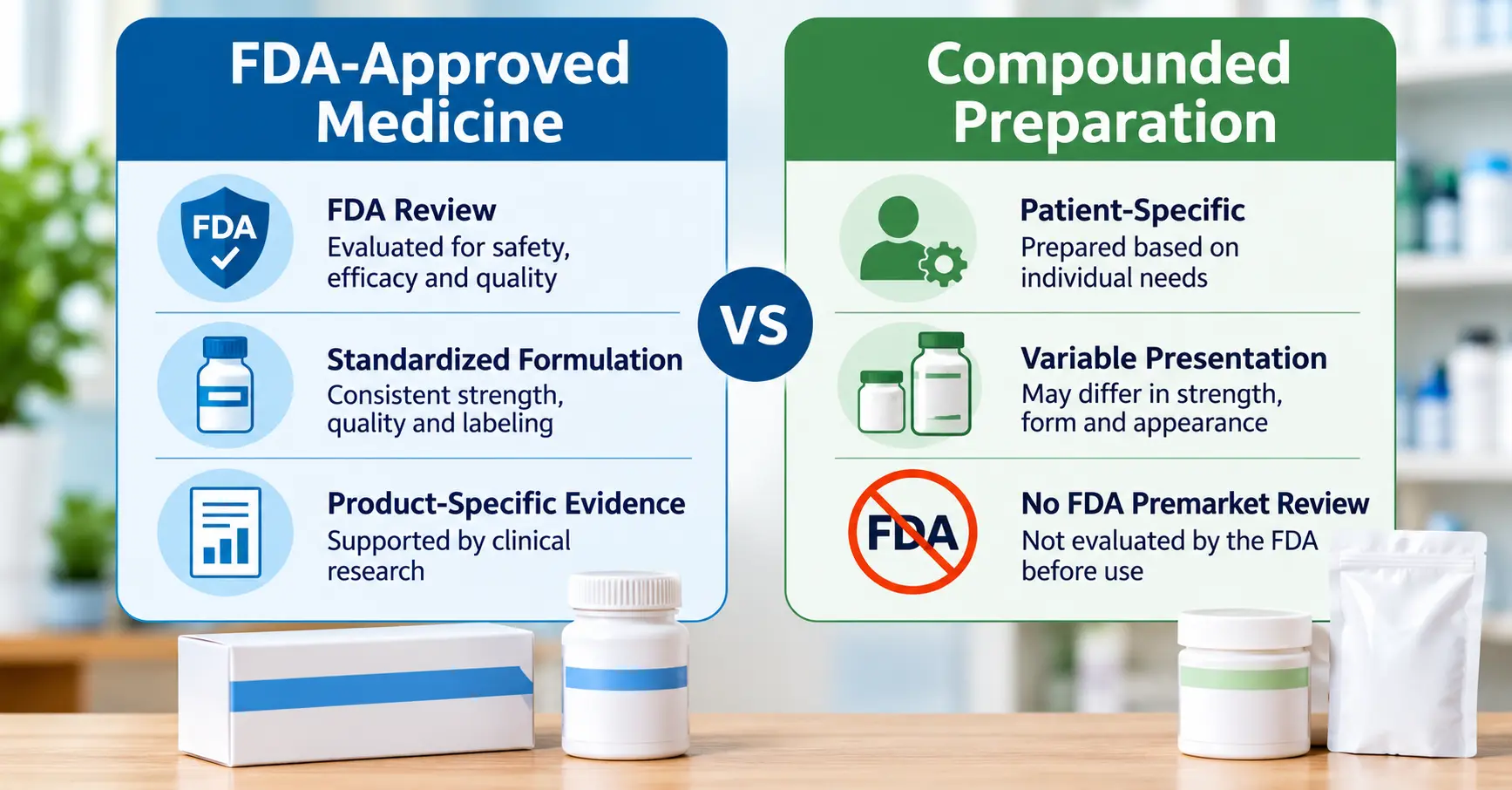
The details of a compounded preparation vary by compounder and prescription. The table summarizes the general difference in regulatory status; it cannot establish the quality of a specific product.

| Feature | FDA-approved product | Compounded preparation |
|---|---|---|
| FDA approval | Reviewed for its labeled product, formulation, and uses. | Not FDA-approved; not a generic equivalent. |
| Manufacturing and oversight | Made under the quality system required for approved drugs. | Requirements depend on whether it is made under 503A or 503B and on applicable state and federal law; it is not FDA premarket-reviewed. |
| Form and dose | Product-specific labeled strengths, devices, and directions. | May vary in concentration, container, and instructions. |
| Dosing consistency | Standardized labeled doses and product instructions. | Vial measurements may require drawing up a dose; concentration and syringe instructions can differ. |
| Clinical evidence | Evidence supports the particular studied and approved products for their labeled uses. | Evidence from an approved product does not validate every compounded formulation. |
| Quality checks | FDA reviews manufacturing information as part of approval and oversees manufacturing requirements. | No FDA premarket review of the compounded product; quality depends on the compounder and legal/quality controls that apply. |
| Availability and cost | Prescription access, coverage, and out-of-pocket cost vary. | Advertised costs and included services vary; price does not show quality or legality. |
What Does the Evidence Say About Effectiveness?
In the STEP 1 randomized trial, adults with overweight or obesity without diabetes who received semaglutide 2.4 mg weekly alongside lifestyle intervention lost an average of 14.9% of body weight over 68 weeks, compared with 2.4% for placebo. These are trial averages, not individual predictions. The study evaluated a defined product and protocol—not every compounded preparation.
There is no basis for assuming that a compounded product will produce the same results. Ingredient name alone does not establish concentration, dose accuracy, stability, sterility, or clinical equivalence. Evidence for FDA-approved semaglutide therefore should not be presented as proof of the effectiveness of an individual compounded product.
Safety, Side Effects, and Product-Quality Concerns
FDA-approved products are not risk-free. Their prescribing information describes common gastrointestinal effects such as nausea, diarrhea, vomiting, constipation, and abdominal discomfort, as well as less common but serious risks. Semaglutide labels include a boxed warning about thyroid C-cell tumors observed in rodents and contraindicate use for people with a personal or family history of medullary thyroid carcinoma or multiple endocrine neoplasia syndrome type 2. Labels also warn about pancreatitis, gallbladder disease, and low blood sugar when used with some diabetes medicines. A clinician should review the current label and a patient’s history.
Compounded injectable products can add practical risks. FDA has received reports of dosing errors, including overdoses associated with confusion among milligrams, milliliters, and syringe “units,” and with different product concentrations. Some reports involved medical attention or hospitalization. Multi-dose vials require accurate measurement and clear instructions; a syringe unit is a volume marking, not a universal semaglutide dose.
Poor compounding practices can result in contamination or too much or too little active ingredient. FDA has also cautioned about semaglutide salt forms and combinations with ingredients whose safety and effectiveness have not been established. Avoid unverified sellers and social-media dosing instructions.
Medical caution
Do not start, stop, or change a prescription based on an online article. If you have severe symptoms or think a medication dose was wrong, contact a healthcare professional or seek urgent care as appropriate.
Current FDA Position and Compounding Rules
FDA determined the national shortage of semaglutide injection products was resolved on February 21, 2025. Its notice provided temporary enforcement-discretion periods for certain shortage-related conditions: through April 22, 2025, for section 503A compounders, and through May 22, 2025, for section 503B outsourcing facilities. FDA later stated that those periods had ended. The temporary transition should not be described as a continuing blanket authorization to make copies.
In an FDA policy update dated April 1, 2026, the agency said semaglutide did not appear on its drug shortage list or its 503B bulks list. That update explains that 503A compounders must meet the prescription and “essentially a copy” conditions, while 503B facilities may use bulk substances only under the statutory conditions. FDA also said it did not intend, at that time, to take action under the “essentially a copy” restriction against a 503A compounder filling four or fewer prescriptions for a compounded drug product in a calendar month. That is enforcement discretion, not a statutory exemption or blanket authorization. FDA’s April 30, 2026 announcement proposed excluding semaglutide, tirzepatide, and liraglutide from the 503B bulks list; a proposal is not a final determination. At the November 17, 2026 source check, we could not verify a later final determination; check the FDA announcement before publication. For the FDA’s current public position, see its April 30, 2026 announcement.
Federal requirements, FDA guidance, and enforcement discretion are distinct. Whether a particular prescription or preparation meets applicable law depends on its facts, the compounder, the patient’s needs, and relevant state requirements. This summary is not a legal opinion. For broader context, continue with the related educational guide below.
Why Do People Ask About Compounded Products?
People may encounter compounded semaglutide when comparing advertised prices, telehealth access, or availability. An individualized need may sometimes be relevant, but it does not establish that a product is lawful, appropriate, or equivalent. Prices may cover different services; a lower price is not evidence of quality.
For an online service, check who makes clinical decisions, which pharmacy dispenses medication, what formulation is offered, and what follow-up is included. For context, the review below describes one weight-management platform based on its public information; it is not a medication recommendation or verification that a particular treatment is suitable.
Questions to Ask a Healthcare Professional
- Is an FDA-approved semaglutide product appropriate for me?
- What specific need would compounding address that an approved product cannot?
- Which pharmacy will dispense it, and how can I verify its license?
- What are the exact formulation, concentration, and prescribed dose?
- What device and written instructions should I use?
- Which side effects need prompt medical attention?
- What follow-up and monitoring will be provided?
Frequently Asked Questions
No. FDA does not review compounded drugs for safety, effectiveness, or quality before marketing.
No. Sharing the ingredient name does not make it the same product, formulation, or dose as Ozempic or Wegovy.
No. Compounded semaglutide is not an FDA-approved generic and does not establish therapeutic equivalence to Wegovy.
Prices and included services vary. A lower advertised price does not prove quality, safety, or effectiveness.
Sometimes, when specific federal and state requirements are met. It is not a blanket substitute for commercially available FDA-approved products.
Safety cannot be established from an article. FDA has reported dosing errors with compounded injectable semaglutide; discuss any specific product with a qualified professional.
Approved products use semaglutide base. FDA says sodium and acetate salts are different active ingredients, not established equivalents.
Conclusion
Approved semaglutide medicines and compounded preparations differ in review, formulation controls, and supporting evidence. Compounding may address a specific need, but it does not create an FDA-approved generic or establish equivalent outcomes. Discuss options with a qualified healthcare professional.
📚 Related Articles
Explore more evidence-based guides, supplement reviews, and practical wellness articles to better understand ingredients, benefits, limitations, and how different products compare.
- ➡️ Medical Weight Loss: Understanding GLP-1 Treatments, Benefits and Risks
- ➡️ Semaglutide vs Tirzepatide: Weight Loss, Risks & Cost
- ➡️ HealSend Review: GLP-1 Treatments, Costs, Benefits & Potential Risks
- ➡️ How Much Do GLP-1 Treatments Cost?
- ➡️ Healthy Weight Benefits: Physical & Mental Health Impact
- ➡️ NR vs NMN vs NAD+: Key Differences, Benefits, and What Research Shows
- ➡️ What Is NAD+? Benefits, Functions & What the Science Says
- ➡️ Genuine Purity Longevity+ Review
- ➡️ Genuine Purity NMN Trial Review
- ➡️ Healthy Aging Supplements Explained
- ➡️ What Is Berberine? Benefits, Uses, Side Effects & How It Works
- ➡️ Berberine Benefits for Blood Sugar and Metabolic Health
- ➡️ Hydration Benefits: Health Tips for Daily Water Intake
- ➡️ How to Support Healthy Blood Sugar Levels Naturally
- ➡️ The Importance of Quality Sleep for a Healthier Life
- ➡️ The Benefits of Magnesium for Sleep and Stress
- ➡️ Revive Daily Review
- ➡️ Java Burn Review: Ingredients, Benefits, Pros & Cons
References
- U.S. Food and Drug Administration. FDA clarifies policies for compounders as national GLP-1 supply begins to stabilize. Updated April 1, 2026.
- U.S. Food and Drug Administration. Compounding when drugs are on FDA’s Drug Shortages List.
- U.S. Food and Drug Administration. Compounding and the FDA: Questions and Answers.
- U.S. Food and Drug Administration. FDA alerts health care providers, compounders and patients of dosing errors associated with compounded injectable semaglutide products. July 26, 2024.
- U.S. Food and Drug Administration. FDA proposes to exclude semaglutide, tirzepatide, and liraglutide on 503B bulks list. April 30, 2026.
- U.S. Food and Drug Administration. Drug Shortages Database, and FDA announcement on the 503B bulks list.
- U.S. Food and Drug Administration. Drugs@FDA: Wegovy, NDA 215256; Wegovy tablets, NDA 218316; Ozempic, NDA 209637; and Rybelsus/Ozempic oral products, NDA 213051.
- Wilding JPH, Batterham RL, Calanna S, et al. Once-Weekly Semaglutide in Adults with Overweight or Obesity. New England Journal of Medicine. 2021;384:989–1002. PubMed record. doi:10.1056/NEJMoa2032183.
Regulatory information and product labels can change. Check the current FDA shortage database, rulemaking docket, and prescribing information before publication or making a treatment decision.