

Author: VitaWeller Health & Wellness Editorial Team
Evidence Reviewed: Peer-reviewed studies, systematic reviews, and guidance from recognized health organizations (NIH, NCCIH, ADA, Mayo Clinic).
Editorial Standards: Evidence-based • Independently researched • Fact-checked before publication
Introduction
Online GLP-1 prescriptions often start with a health questionnaire. What matters is what happens next: who reviews your answers, whether they need more information, and what care is available after the visit. The point of a telehealth consultation is to find out whether treatment makes sense for you, not simply to place an order.
This guide covers U.S. telehealth and FDA rules. Other countries follow their own prescribing and pharmacy requirements.
Evidence Review: What Sources Does This Guide Use?
Scope: U.S. prescribing information and federal health guidance. This guide explains the process; it does not compare the clinical outcomes of telehealth programs.
- Medication use and safety: U.S. prescribing information describes what each product is approved for and its warnings. NIH/NIDDK guidance explains how medication fits into longer-term weight management.
- Compounding and pharmacy safety: FDA guidance explains how compounded drugs differ from approved drugs and flags warning signs to look for when considering an online service.
- Telehealth requirements: HHS guidance explains how state licensure affects who can provide care across state lines. Visit formats and follow-up arrangements can vary by provider.
HealSend’s program description and terms are used only to describe what the company offers. They are not clinical evidence or independent verification of the service.
Quick Answer
GLP-1 medication can be prescribed online in the U.S., but a consultation does not guarantee a prescription. The clinician must be authorized to treat you where you are located and decide whether the medication is appropriate. They may need records, tests, or an in-person exam before deciding.
If a prescription is issued, confirm which pharmacy will fill it, whether the product is FDA-approved or compounded, and who you can contact about side effects or follow-up care.
Three things to know before you sign up
What are online GLP-1 prescriptions?
The word online describes how you see the clinician and how the prescription may be sent, not a different kind of medication. A telehealth clinic evaluates you and may prescribe. A pharmacy dispenses the medicine. A website offering to sell a prescription-only drug without an evaluation and a valid prescription is not providing the same service.
GLP-1 receptor agonists such as semaglutide act on a hormone pathway involved in appetite and blood sugar regulation. Tirzepatide acts on two receptors, GIP and GLP-1. It is often grouped under the shorthand “GLP-1,” but the two medications are not interchangeable. Some products containing these ingredients can support long-term weight management for eligible patients, alongside nutrition and physical activity support. Our guide to medically supervised GLP-1 treatment explains the benefits and limitations in more detail.
How does the online GLP-1 prescription process work?
Services organize these steps differently. A useful way to compare them is to ask what you are paying for at each stage and who is responsible for the next one.
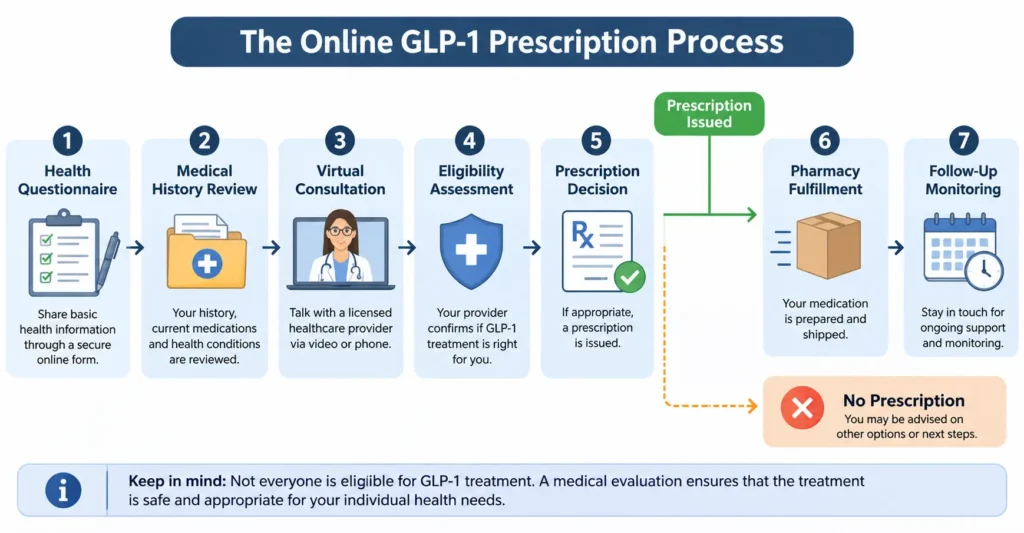
1. Complete a health questionnaire
Expect questions about your measurements, health goals, diagnoses, and medications. The questionnaire gives the clinician a starting point; it does not establish eligibility by itself.
2. Have your medical history reviewed
The clinician may ask for recent records or clarify details such as which diabetes drugs you take or what happened during a previous weight-management treatment.
3. Consult a licensed clinician
The format may be video, phone, or secure messaging, depending on the service, applicable rules, and what the clinician needs to evaluate. Confirm the clinician is authorized to treat patients where you are physically located during the visit.
4. Discuss whether medication is appropriate
The clinician weighs the potential benefits, risks, treatment alternatives, and what follow-up is feasible. You might be asked to get lab work or see someone in person. Sometimes the answer is that a different treatment would be more appropriate.
5. Receive a prescription if appropriate
If treatment is agreed on, the clinician can send a prescription to an appropriate pharmacy. Insurance authorization, where required, is a separate step. Ask which product is being prescribed and whether you can choose the pharmacy.
6. Arrange pickup or delivery
Depending on the pharmacy, you may pick up the medication or have it shipped. Check the label against the product discussed at your visit. If the packaging is damaged, the product looks unfamiliar, or a refrigerated medication arrives warm, contact the dispensing pharmacy before using it.
7. Plan for follow-up
Before the first fill, confirm whether follow-up is included, how refills are handled, and whether you can reach a clinician between visits. Pharmacy questions and clinical problems may go to different people.
What information do healthcare providers need?
Bring a current medication and supplement list, your height and weight, and any relevant records. It helps to explain what you have already tried and why it was difficult to continue. Depending on your history, a clinician may want to see blood sugar results or other lab work, but there is no one set of tests that applies to everyone.
BMI is one part of the assessment. For chronic weight management, some U.S. labels describe adults with obesity or adults with overweight and at least one weight-related condition. The right criteria depend on the exact product and reason for prescribing. A BMI result on a sign-up form does not tell you whether the benefits outweigh the risks.
Common topics include diabetes, past pancreatitis or gallbladder problems, severe digestive symptoms, allergies, and pregnancy or plans for pregnancy. Certain products, including Wegovy and Zepbound, are contraindicated in people with a personal or family history of medullary thyroid carcinoma or with multiple endocrine neoplasia syndrome type 2. Bring any relevant history to the visit rather than trying to screen yourself.

Can semaglutide or tirzepatide be prescribed online?
Yes, when the clinician is authorized to prescribe and the evaluation supports it. In the U.S., Wegovy (semaglutide) and Zepbound (tirzepatide) have FDA-approved uses for chronic weight management in eligible patients. Ozempic and Mounjaro have FDA-approved uses related to type 2 diabetes; they are not the branded products approved specifically for chronic weight management. Product labels may include other indications. The ingredient name alone does not tell you what is being prescribed or why.
If you are comparing an online semaglutide prescription with an online tirzepatide prescription, talk through the exact product, its intended use, and what follow-up would look like.
FDA-approved vs. compounded GLP-1 medications
FDA approval applies to a specific drug product and its labeled uses. Before approval, the agency evaluates evidence on safety, effectiveness, and quality. Compounding involves making or modifying a preparation. Compounded drugs are not FDA-approved and do not go through that premarket review, even when the ingredient name is familiar.
Compounding can meet a particular medical need an approved drug cannot meet. That does not make a compounded preparation equivalent to an FDA-approved product. The FDA has flagged problems with some unapproved GLP-1 products, including dosing errors and refrigerated shipments arriving warm. U.S. federal restrictions apply to compounding copies of commercially available or approved drugs, and the rules differ for different kinds of compounding facilities. Shortage status can affect which restrictions apply, so a past shortage announcement does not establish what is permitted now.
If a service offers a compounded product, ask why it is being offered, who makes and dispenses it, and whether an FDA-approved option can meet your needs. Our guide to compounded and FDA-approved semaglutide explains what that distinction means for patients.
How much do online GLP-1 programs cost?
An advertised monthly price may cover the medication, the clinical service, or both. Ask for the first month’s total and the typical recurring total in writing. Separate the consultation, membership, medication, pharmacy or shipping charges, follow-up visits, and any required labs. Ask what is refundable if you are not prescribed medication and when a subscription renews.
In the U.S., the visit and medication can be covered differently. Ask your insurer about the exact product, indication, pharmacy, and prior authorization rules; do not assume coverage because another drug with the same ingredient is on the plan.
Are online GLP-1 prescriptions safe?
A remote visit does not remove medication risks. Safety depends on whether the clinician has enough information, the pharmacy is legitimate, the product is sourced transparently, and you can reach the care team. Common side effects can include nausea, vomiting, diarrhea, or constipation. The exact product label covers other warnings, including pancreatitis and, in some circumstances, low blood sugar when used with certain diabetes medicines.
How to choose a legitimate online GLP-1 provider
- Check who treats you. Can you find the prescriber’s name and verify their authorization with the relevant state licensing board?
- Look for a real evaluation. Is someone reviewing your medical history, discussing alternatives, and able to say no?
- Identify the pharmacy. Can you verify its state license, find contact information, and talk to a pharmacist? The FDA’s BeSafeRx resources can help.
- Ask what will be dispensed. Is the exact product identified, its source explained, and its status as FDA-approved or compounded made clear?
- Read the payment terms. Are fees, renewals, and cancellation terms clear before you pay?
- Find out who handles problems. Is there a clinical follow-up plan, a way to report side effects, and guidance for urgent symptoms?
Guaranteed prescriptions, dramatic weight-loss promises, vague pharmacy information, and products offered without clinical screening are reasons to walk away. A professional-looking site is not evidence that the prescriber or pharmacy is licensed.
HealSend: One example of an online weight-management service
HealSend is a platform that connects users with independent medical practices, not a medication or the prescriber. The program offers an online assessment and advertises compounded options. If you use the review to compare services, confirm the current terms directly with HealSend and ask who would prescribe, which pharmacy would fill the prescription, and what follow-up is included. This is not a clinical endorsement or independent verification of the program’s clinicians or medication quality.
What happens after starting GLP-1 treatment?
During follow-up, the clinician can look at your treatment response, side effects, and any relevant health measures. Tell them if eating or drinking has become difficult, if your other medications have changed, or if you are planning a procedure. Dose changes and decisions about switching or stopping should be discussed with the prescribing clinician.
Long-term care can also include support for eating patterns, physical activity, and other habits that are realistic for you. If treatment becomes difficult to tolerate or afford, ask what a change would mean and what support would continue. Weight regain can happen after stopping, so it helps to discuss a plan before a gap in care.

Frequently asked questions
Yes, if a qualified clinician decides treatment is appropriate and can prescribe under the rules where you are located. Some people will need an in-person evaluation first.
Not every service uses video. Check what format the provider offers in your state and whether a live visit is needed for your assessment.
There is no standard turnaround. A delayed appointment, missing records, lab work, or an insurance decision can add time. The prescription decision and the delivery estimate are separate.
They may, when clinically and legally appropriate. Ask which semaglutide product is being considered and whether it is FDA-approved or compounded.
They may. For weight management, ask whether the clinician is considering Zepbound or a compounded preparation and what explains that choice.
Yes. An intake form can collect information, but a licensed prescriber still needs to evaluate whether the medication is appropriate. A checkout screen is not a medical assessment.
It depends on your plan, the exact product, the reason it is prescribed, and where you fill it. Check the visit, medication, and any required labs separately.
Some pharmacies ship to eligible addresses. Ask how the pharmacy handles storage in transit and who to contact if the package is late, damaged, or improperly cooled.
Some provide legitimate remote care. Look for an identifiable prescriber, a licensed pharmacy, a real evaluation, and a way to reach the clinician after the first visit.
What matters more than a quick prescription
Telehealth can make it easier to talk about weight-management treatment without traveling to a clinic. When comparing providers, look beyond price and appointment speed. You should know who makes the treatment decision, what the pharmacy would dispense, and how to get clinical help if the plan needs to change.
📚 Related Articles
Explore more evidence-based guides, supplement reviews, and practical wellness articles to better understand ingredients, benefits, limitations, and how different products compare.
- ➡️ HealSend Review: GLP-1 Treatments, Costs, Benefits & Potential Risks
- ➡️ Medical Weight Loss: Understanding GLP-1 Treatments, Benefits and Risks
- ➡️ How Much Do GLP-1 Treatments Cost?
- ➡️ Semaglutide vs Tirzepatide: Weight Loss, Risks & Cost
- ➡️ Compounded Semaglutide vs. FDA-Approved Semaglutide: Key Differences, Safety & What to Know
- ➡️ Healthy Weight Benefits: Physical & Mental Health Impact
Sources and references
- NIH/NIDDK: Prescription medications to treat overweight and obesity
- Wegovy U.S. prescribing information and Medication Guide
- Zepbound U.S. prescribing information and Medication Guide
- Ozempic U.S. prescribing information and Mounjaro U.S. prescribing information
- FDA: Concerns with unapproved GLP-1 drugs used for weight loss
- FDA: Compounding questions and answers, FDA: Conditions for GLP-1 compounding, and FDA: Drug shortages
- HHS: Telehealth licensing across state lines