

Author: VitaWeller Health & Wellness Editorial Team
Evidence Reviewed: Peer-reviewed studies, systematic reviews, and guidance from recognized health organizations (NIH, NCCIH, ADA, Mayo Clinic).
Editorial Standards: Evidence-based • Independently researched • Fact-checked before publication
Introduction
Berberine has become one of the most popular natural supplements for supporting healthy blood sugar levels, metabolic health, and weight management. Traditionally, it has been taken in capsule form, but a newer alternative has started gaining attention: berberine patches.
Instead of swallowing capsules once or twice a day, these patches are applied directly to the skin and claim to provide a slow, continuous release of berberine throughout the day.
Naturally, many people are asking:
- Do berberine patches actually work?
- Can berberine really be absorbed through the skin?
- Are patches as effective as capsules?
The short answer is possibly—but the scientific evidence is still limited.
In this article, we’ll examine how berberine patches are supposed to work, what current research says, and whether they are a practical alternative to traditional supplements.
🔬 Evidence Review
Evidence Level: ★★★☆☆ Moderate Evidence
- ✅ Strong clinical evidence supports the benefits of oral berberine for healthy blood sugar and metabolic health.
- ✅ Laboratory and pharmaceutical research suggests that transdermal berberine delivery is scientifically feasible.
- ⚠️ There are currently no large published human clinical trials confirming the effectiveness of commercially available berberine patches.
- 💡 Berberine patches may offer greater convenience and help avoid digestive discomfort associated with oral supplements, but more human research is needed.
Last evidence review: July 2026 • Based on currently available human clinical studies and published research on transdermal drug delivery.
What Are Berberine Patches?
Berberine patches are adhesive skin patches designed to deliver small amounts of berberine through the skin over several hours.
Unlike capsules that must pass through the digestive system, patches attempt to deliver ingredients gradually via the skin.
Manufacturers claim this method may:
- provide steady release
- avoid stomach discomfort
- improve convenience
- eliminate the need to remember multiple daily capsules
However, the effectiveness of any transdermal supplement depends on one important question:
Can enough berberine actually pass through the skin?
How Are Berberine Patches Supposed to Work?
The outer layer of the skin (the stratum corneum) acts as a powerful protective barrier.
Only certain molecules can successfully pass through it.
To improve absorption, manufacturers may use technologies such as:
- permeation enhancers
- carrier molecules
- nano-emulsion systems
- controlled-release adhesives
The goal is to allow small amounts of berberine to slowly diffuse through the skin into circulation.
While this concept is scientifically plausible, absorption depends heavily on the formulation used, and most commercial products have not published human absorption studies.
Some berberine patches, such as Purisaki Berberine Patch , use a transdermal delivery approach designed to provide a slow and convenient release of berberine through the skin. However, the effectiveness of individual products depends on their formulation, and more human research is needed to confirm absorption levels.
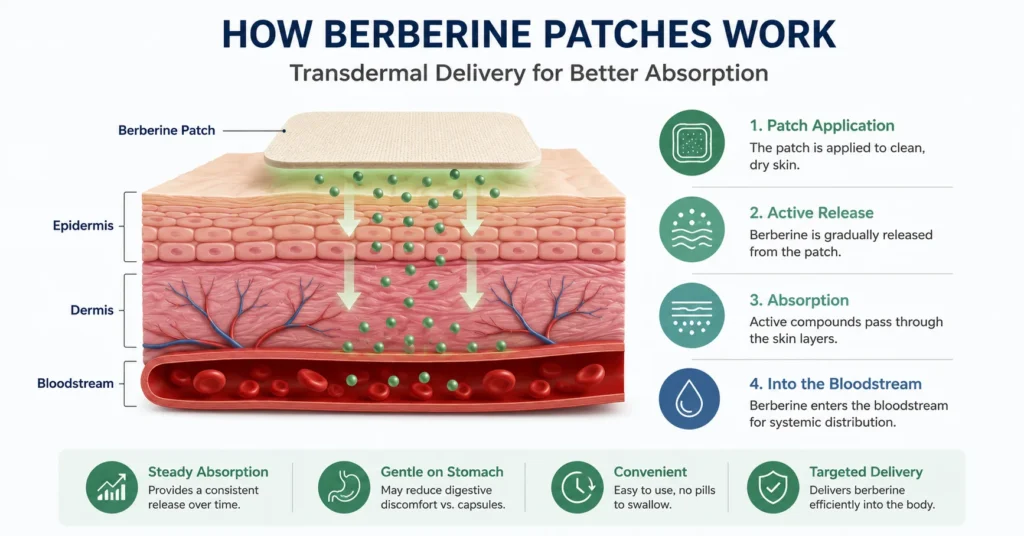
📌 Important Note
This illustration demonstrates the proposed mechanism of transdermal berberine delivery. While laboratory research suggests that berberine can potentially be delivered through the skin using specialized formulations, the actual absorption and effectiveness of commercially available berberine patches have not yet been confirmed by large human clinical trials.
What Does the Scientific Evidence Say?
This is where it’s important to separate established science from marketing claims.
Strong evidence for oral berberine
Researchers have studied oral berberine for decades.
Clinical trials suggest that oral berberine may help support:
- healthy blood sugar
- insulin sensitivity
- cholesterol levels
- metabolic health
Most published evidence involves capsules—not patches.
Most of the published clinical research has focused on oral berberine, with studies suggesting benefits for healthy blood sugar levels, insulin sensitivity, and metabolic health. Learn more in our guide: Berberine Benefits for Blood Sugar and Metabolic Health .
Experimental evidence for transdermal berberine
Scientists have investigated transdermal delivery systems in laboratory settings.
Experimental studies suggest that specially designed delivery systems may improve skin penetration.
However, these studies generally involve pharmaceutical formulations rather than consumer wellness patches.
Human evidence is still limited
At the time of writing:
- no large randomized clinical trials have demonstrated that commercial berberine patches deliver the same benefits as oral supplements
- most available evidence comes from laboratory research and formulation studies
This doesn’t necessarily mean patches don’t work.
It simply means they have not yet been studied as extensively.
Research Summary
| Topic | Current Evidence |
|---|---|
| Oral berberine | Strong |
| Transdermal technology | Promising |
| Consumer berberine patches | Limited |
| Human clinical trials | Very limited |
Can Berberine Really Pass Through the Skin?
This is probably the biggest question consumers ask.
Berberine is not considered an ideal molecule for passive skin absorption because of its chemical properties.
Researchers are exploring advanced delivery technologies to improve penetration, including:
- nanoparticles
- liposomes
- microneedle systems
- permeation enhancers
These technologies are promising but are not necessarily used in every commercial patch available today.
Berberine Patches vs Capsules
| Feature | Capsules | Patches |
|---|---|---|
| Clinical evidence | Excellent | Limited |
| Convenience | Moderate | Excellent |
| Digestive side effects | Possible | May be reduced |
| Daily routine | Multiple doses | Single application |
| Proven absorption | Yes | Uncertain |
For people seeking the strongest scientific evidence, capsules remain the better-supported option.
For people prioritizing convenience, patches may still be worth considering.
Prefer Capsules Over Patches? See Our Top Berberine Supplements (2026)
While berberine patches are a convenient option, capsules currently have the strongest scientific support. Explore our top-rated berberine supplements based on ingredients, dosage, value, and overall quality.
Compare the Best Berberine Supplements →Are Berberine Patches Better for People With Sensitive Stomachs?
Some people stop taking oral berberine because of digestive side effects such as:
- nausea
- stomach discomfort
- diarrhea
- bloating
Since patches bypass the digestive tract, they may reduce these issues.
However, this benefit has not yet been confirmed in large human studies specifically involving berberine patches.
Although berberine is generally well tolerated, some people experience digestive discomfort when taking capsules. If you’d like to learn more about these potential reactions, read our article: Berberine Side Effects: What You Should Know .
Who Might Prefer Berberine Patches?
Berberine patches may appeal to people who:
- dislike swallowing capsules
- travel frequently
- forget daily supplements
- prefer wearable wellness products
- experienced digestive discomfort with capsules

What About Purisaki Berberine Patches?
One of the better-known products currently available is Purisaki Berberine Patch.
Rather than making unrealistic claims, Purisaki focuses on convenience and sustained delivery through a wearable patch.
Because independent clinical evidence on commercial berberine patches remains limited, it’s important to evaluate any product based on:
- ingredient transparency
- manufacturer reputation
- customer feedback
- realistic expectations
📦 Purisaki Berberine Patch Review
Looking for a capsule-free alternative to traditional berberine supplements?
Wondering whether Purisaki is worth trying? Read our complete review covering ingredients, pricing, customer feedback, advantages, disadvantages, and who this patch may be best suited for.
Read the Full Purisaki Review →Frequently Asked Questions
They may work for some users, but there is currently limited clinical evidence supporting commercial berberine patches. Oral berberine remains much better studied.
Potentially yes, but successful absorption depends on the delivery technology used in the patch.
Dietary supplement patches are generally not FDA-approved in the same way as prescription medications.
Not necessarily. Capsules currently have much stronger scientific evidence supporting their effectiveness.
If your priority is clinical evidence, capsules remain the better-supported option.
If convenience and avoiding digestive discomfort are your priorities, patches may be worth considering.
Final Verdict
Berberine patches represent an interesting development in the supplement market, especially for people looking for a more convenient alternative to capsules.
While the concept of transdermal delivery is scientifically plausible and supported by promising laboratory research, there is currently limited human evidence confirming that commercial berberine patches deliver the same benefits observed with oral berberine supplements.
For now, the strongest scientific support remains with traditional berberine capsules. However, patches may still be a practical option for individuals who value convenience or have difficulty tolerating oral supplements.
As with any supplement, it’s important to keep expectations realistic and choose products from reputable manufacturers with transparent ingredient information.
If you decide that capsules are the better option for you, you may also want to read our guide on When Is the Best Time to Take Berberine? to learn how timing may influence effectiveness and tolerability.
📖 Compare Delivery Methods
Not sure whether berberine patches or capsules are the better choice?
Our in-depth comparison explains the differences in absorption, convenience, scientific evidence, and who each option may be best suited for.
Read Berberine Patches vs Capsules →📚 Related Articles
Continue exploring our evidence-based guides on berberine supplements, blood sugar support, and metabolic health.
- ➡️ Purisaki Berberine Review (2026)
- ➡️ How to Use Berberine Patches Correctly
- ➡️ Berberine Patches vs Capsules: Which Option Is Better?
- ➡️ Berberine Benefits for Blood Sugar and Metabolic Health
- ➡️ Best Berberine Supplements for Blood Sugar Support (2026)
- ➡️ When Is the Best Time to Take Berberine?
- ➡️ Berberine Side Effects: What You Should Know
- ➡️ How to Support Healthy Blood Sugar Levels Naturally
- ➡️ Genuine Purity Berberine HCL Review
- ➡️ Jeemya Berberine HCl 800mg Review
🔬 Scientific References
The information in this article is based on peer-reviewed scientific literature and review papers examining berberine, metabolic health, and transdermal drug delivery.
Berberine
- Yin J, Xing H, Ye J. Efficacy of Berberine in Patients with Type 2 Diabetes Mellitus
- Berberis vulgaris and Berberine: An Update Review
- Berberine and Barberry (Berberis vulgaris): A Clinical Review
Transdermal Drug Delivery
📢 Affiliate Disclosure
Some links on VitaWeller are affiliate links. If you purchase a product through these links, we may earn a small commission at no additional cost to you. This helps support our website and allows us to continue creating evidence-based health content. Our recommendations are based on independent research, product evaluation, and editorial standards—not on affiliate partnerships.