

Author: VitaWeller Health & Wellness Editorial Team
Evidence Reviewed: Peer-reviewed studies, systematic reviews, and guidance from recognized health organizations (NIH, NCCIH, ADA, Mayo Clinic).
Editorial Standards: Evidence-based • Independently researched • Fact-checked before publication
Quick Answer
For most people, the best time to take berberine is about 15–30 minutes before meals or with meals, divided into two or three daily doses. This timing may help support healthy post-meal blood sugar levels while reducing the chance of digestive discomfort. If taking berberine on an empty stomach causes stomach upset, taking it with food is usually the better option.
Introduction
Berberine has become one of the most researched natural compounds for supporting healthy blood sugar, metabolic health, cholesterol levels, and weight management. While choosing a high-quality supplement is important, when you take berberine may also influence your experience and overall results.
Unlike many dietary supplements that can be taken at any convenient time, berberine has a relatively short half-life and works alongside your body’s response to meals. Because of this, healthcare professionals and clinical studies often recommend dividing the daily dosage rather than taking it all at once.
Many people ask questions such as:
- Should I take berberine before meals?
- Is it better with food or on an empty stomach?
- Should I take it in the morning or before bed?
- Does timing matter for weight loss?
- What if I only take it once a day?
In this guide, we’ll answer each of these questions using current scientific evidence and practical recommendations.
Whether your goal is supporting healthy glucose metabolism, improving metabolic health, or simply getting the most from your supplement, understanding the best timing can help you build a consistent routine.
Table of Contents
- Why Timing Matters
- Should You Take Berberine Before or After Meals?
- Morning vs. Evening: Which Is Better?
- Should You Take Berberine on an Empty Stomach?
- Best Time to Take Berberine for Blood Sugar Support
- Best Time to Take Berberine for Weight Management
- Best Daily Schedule
- Common Mistakes to Avoid
- Frequently Asked Questions
- Final Thoughts
Why Does Timing Matter?
Many supplements remain in the bloodstream for long periods after they’re taken. Berberine behaves somewhat differently.
Research suggests that berberine has a relatively short half-life, meaning blood levels gradually decline within several hours. For this reason, researchers frequently divide the total daily dose into two or three servings instead of recommending one large daily dose.
This approach may help maintain more consistent exposure throughout the day while supporting the body’s normal metabolic processes around meal times.
Timing can also influence:
- blood sugar response after meals
- digestive comfort
- consistency of supplementation
- overall adherence to a daily routine
Although taking berberine at exactly the same minute every day isn’t necessary, maintaining a regular schedule may help you remember your doses and avoid missing them.
Why Meals Make a Difference
Most carbohydrates are broken down into glucose shortly after eating. Blood sugar naturally rises after a meal before returning toward normal levels.
Berberine has been studied for its role in supporting healthy glucose metabolism, which is why many clinical trials instruct participants to take it shortly before meals or with meals.
This timing aligns the supplement with the period when your body is actively processing nutrients.
For people who experience stomach discomfort from supplements, taking berberine with food may also improve tolerability.
Should You Take Berberine Before or After Meals?
The Short Answer
For most adults, taking berberine 15–30 minutes before meals—or with meals if stomach sensitivity is a concern—is generally considered the most practical approach.
There isn’t strong evidence showing that taking berberine after meals provides additional benefits over taking it before eating.
Instead, most research protocols use one of these approaches:
| Timing | Advantages | Potential Drawbacks |
|---|---|---|
| 15–30 minutes before meals | Often used in clinical studies, aligns with digestion and post-meal glucose response | May cause mild stomach discomfort in sensitive individuals |
| With meals | Easier on the stomach, improves consistency for many people | May slightly delay absorption, though clinical significance is unclear |
| After meals | May still be effective if taken consistently | Less commonly used in research protocols |
The most important factor is consistency.
Missing doses regularly is likely to have a greater impact than choosing between taking berberine 20 minutes before a meal or during the meal itself.
If You Have a Sensitive Stomach
Some users report temporary digestive side effects when starting berberine, including:
- mild nausea
- stomach cramps
- bloating
- loose stools
These symptoms are often temporary and may improve as the body adjusts.
If this happens:
✅ Take berberine with food.
✅ Start with a lower dose if recommended by your healthcare provider.
✅ Increase gradually over one to two weeks if appropriate.
Many people find that these simple adjustments improve comfort without reducing the supplement’s potential benefits.
Morning vs. Evening: Which Is Better?
One of the most common misconceptions is that there is a single “best” time of day to take berberine.
In reality, the ideal timing depends more on your meal schedule than on the clock.
If you take berberine only once daily, many people prefer taking it before their largest carbohydrate-containing meal. However, many clinical studies investigating berberine have used divided doses—typically two or three times per day—rather than a single daily serving.
Morning Berberine
Taking berberine before breakfast may be a good option if:
- breakfast is your largest meal
- you prefer establishing a consistent morning routine
- you only remember supplements in the morning
Midday Berberine
Many people choose lunch because:
- it tends to be a substantial meal
- it fits well into a twice-daily schedule
- it’s easier to remember during a regular work routine
Evening Berberine
Taking berberine before dinner may be appropriate if:
- dinner is your largest meal
- you split doses throughout the day
- your healthcare provider recommends multiple daily servings
Current evidence does not indicate that taking berberine before bed offers unique metabolic advantages compared with taking it around meals.
Instead, maintaining evenly spaced doses throughout the day appears to be the more important factor.
Key Takeaways
- Most studies use 2–3 divided doses rather than one large daily dose.
- Taking berberine 15–30 minutes before meals is common in clinical research.
- If stomach upset occurs, taking it with food is usually a practical alternative.
- Consistency matters more than choosing an exact time on the clock.
- Your meal schedule should guide when you take berberine—not whether it’s morning or evening.
Should You Take Berberine on an Empty Stomach?
One of the most common questions is whether berberine should be taken on an empty stomach or with food.
The answer depends largely on how well your body tolerates the supplement.
While some people have no problem taking berberine before eating, others may experience temporary digestive discomfort such as nausea, bloating, or mild stomach cramps. If that happens, taking berberine with a meal is generally the better option.
Empty Stomach vs. With Food
| Taking Berberine on an Empty Stomach | Taking Berberine With Food |
|---|---|
| Often taken 15–30 minutes before meals | Easier on the digestive system |
| Common approach in clinical studies | Better tolerated by sensitive individuals |
| May better align with post-meal glucose response | Can improve consistency because it’s easier to remember |
| May increase stomach discomfort in some people | Slight differences in absorption are unlikely to be clinically significant |
For most healthy adults, both approaches can be appropriate.
The best choice is the one that allows you to take berberine consistently without unpleasant side effects.
🔍 Find the Right Berberine Supplement
Still comparing products?
Our updated buying guide compares top berberine supplements based on formula quality, berberine dosage, ingredients, price, and overall value.
- ✓ Berberine HCl dosage
- ✓ Ingredient quality & transparency
- ✓ Best options for different goals
- ✓ Pros, cons & key differences
- ✓ Our top recommendations
If Berberine Upsets Your Stomach
Digestive symptoms are among the most commonly reported side effects during the first few weeks.
These may include:
- nausea
- bloating
- constipation
- diarrhea
- stomach discomfort
Fortunately, these effects are often temporary.
Many users notice improvement after one to two weeks as their digestive system adapts.
To reduce discomfort:
- Take berberine with your meal instead of before it.
- Drink a full glass of water.
- Avoid taking your entire daily dose at once.
- Increase the dose gradually if advised by your healthcare provider.
If symptoms are severe or persistent, stop using the supplement and consult a healthcare professional.
📦 Product Spotlight
Looking for a capsule-free alternative to traditional berberine supplements?
We took a closer look at Purisaki Berberine Patches, a transdermal option designed for people who prefer not to swallow capsules.
- ✔ Ingredient breakdown
- ✔ Customer feedback summary
- ✔ Pros & Cons
- ✔ Who it may be best suited for
Best Time to Take Berberine for Blood Sugar Support
If your goal is supporting healthy blood sugar levels, timing becomes more relevant.
After eating carbohydrates, blood glucose naturally rises. Berberine has been studied for its role in supporting normal glucose metabolism during this period.
Because of this, many clinical trials instructed participants to take berberine shortly before meals.
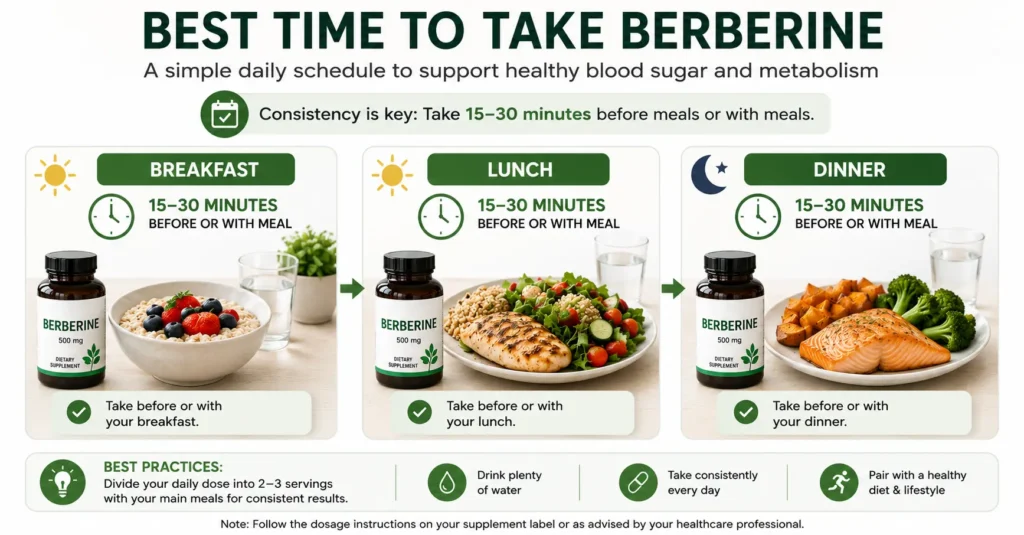
A practical schedule often looks like this:
| Meal | Suggested Timing |
|---|---|
| Breakfast | 15–30 minutes before or with breakfast |
| Lunch | 15–30 minutes before or with lunch |
| Dinner | 15–30 minutes before or with dinner |
Splitting the daily dose may help provide more consistent exposure throughout the day compared with taking a single large dose.
Does It Need to Be Exactly 30 Minutes Before Eating?
No.
This is a common misconception.
The evidence does not suggest that taking berberine exactly 27 or 30 minutes before a meal produces dramatically better results than taking it with the meal.
Instead, consistency is much more important.
For example:
✅ Every day with breakfast and dinner
is likely to be more beneficial than
❌ Taking it 20 minutes before meals on some days but forgetting it entirely on others.
Best Time to Take Berberine for Weight Management
Many people first hear about berberine because of its growing popularity as a supplement for weight management.
However, it’s important to understand that berberine is not a fat-burning supplement.
Instead, research suggests that it may support metabolic health, insulin sensitivity, and glucose regulation, which may indirectly support healthy body weight when combined with:
- a balanced diet
- regular physical activity
- adequate sleep
- long-term healthy habits
Because these metabolic effects are closely related to meals, taking berberine before or with meals remains the most practical recommendation.
Should You Take Berberine Before Exercise?
Current research does not indicate any special benefit from taking berberine immediately before a workout.
Unlike caffeine or creatine, berberine is not intended to provide an acute performance boost.
Your workout schedule does not need to determine when you take it.
Instead, focus on maintaining your normal meal-based dosing routine.
Best Time to Take Berberine for Cholesterol Support
Berberine has also been studied for supporting healthy cholesterol and triglyceride levels.
Unlike blood sugar, cholesterol metabolism is not tied to one specific meal.
Therefore, the exact time of day is probably less important.
Most experts still recommend taking berberine with your regular meals because this:
- improves adherence
- reduces stomach upset
- naturally spreads doses throughout the day
The consistency of daily supplementation is likely to matter more than whether the supplement is taken in the morning or evening.
What Is the Best Daily Schedule?
The ideal schedule depends on how many doses you take each day.
If You Take Berberine Once Daily
Many people choose:
✅ Before or with their largest meal.
Although some supplements are marketed for once-daily use, many clinical studies investigating berberine have used divided doses.
If You Take Berberine Twice Daily
A simple routine could be:
| Time | Example |
|---|---|
| Morning | Before or with breakfast |
| Evening | Before or with dinner |
This schedule is easy to remember and evenly distributes the supplement throughout the day.
If You Take Berberine Three Times Daily
Many research studies have used a schedule similar to:
| Time | Example |
|---|---|
| Morning | Breakfast |
| Midday | Lunch |
| Evening | Dinner |
This provides the most even spacing during waking hours.
Can You Take All Your Berberine at Once?
Generally, this is not the preferred approach unless the specific product label instructs otherwise.
Taking one large dose may:
- increase digestive discomfort
- make nausea more likely
- provide less consistent exposure throughout the day
For this reason, divided doses are commonly recommended in both research settings and clinical practice.
Practical Tips for Getting the Best Results
Regardless of the exact time you choose, these habits can help maximize consistency:
✅ Take berberine at approximately the same meals every day.
✅ Use a pill organizer if you take multiple daily doses.
✅ Set reminders on your phone.
✅ Drink enough water.
✅ Follow the dosage instructions provided on the product label.
✅ Pair supplementation with a healthy lifestyle rather than relying on supplements alone.
At a Glance
| Goal | Best Timing |
|---|---|
| Blood sugar support | Before or with meals |
| Weight management | Before or with meals |
| Cholesterol support | With regular meals |
| Sensitive stomach | With meals |
| Maximum consistency | Same meals every day |
| Once-daily users | Largest meal of the day |
| Two-dose schedule | Breakfast + Dinner |
| Three-dose schedule | Breakfast + Lunch + Dinner |
Common Mistakes to Avoid When Taking Berberine
Berberine has been studied extensively for its potential role in supporting healthy blood sugar, cholesterol levels, and metabolic health. However, simply taking the supplement does not guarantee the best results.
The following are some of the most common mistakes people make when using berberine—and how to avoid them.
1. Taking All of Your Daily Dose at Once
One of the biggest misconceptions is that taking a larger single dose is more effective.
In reality, many clinical studies have used divided doses taken two or three times per day. Because berberine has a relatively short half-life, spreading the total daily amount across meals may help maintain more consistent levels throughout the day.
Instead of taking everything at breakfast, many people benefit from dividing the daily amount between breakfast, lunch, and dinner—or breakfast and dinner if using a twice-daily routine.
2. Taking Berberine Inconsistently
Some people take berberine only when they remember or only before large meals.
Unfortunately, this approach makes it difficult to maintain a consistent supplementation routine.
Rather than worrying about the exact minute you take each dose, focus on taking it at approximately the same meals every day.
Building the habit around breakfast, lunch, or dinner is often more sustainable than relying on memory alone.
3. Expecting Immediate Results
Berberine is not a fast-acting supplement.
Unlike caffeine or some pre-workout ingredients, it is not designed to produce noticeable effects within hours.
Most clinical studies have evaluated berberine over several weeks or months, with participants following a consistent daily routine alongside healthy lifestyle habits.
Patience and consistency are essential.
4. Ignoring Diet and Exercise
Berberine should not be viewed as a replacement for healthy eating or regular physical activity.
Research suggests it may support normal metabolic function, but long-term health depends on multiple lifestyle factors, including:
- eating a balanced diet rich in whole foods
- staying physically active
- maintaining a healthy body weight
- getting adequate sleep
- managing stress
Think of berberine as one part of a broader wellness strategy, not a standalone solution.
5. Choosing a Low-Quality Supplement
Not all berberine supplements are formulated the same way.
When comparing products, consider factors such as:
- clearly labeled dosage
- third-party testing (when available)
- manufacturer reputation
- transparent ingredient list
- absence of unnecessary fillers
Choosing a reputable brand may provide greater confidence in product quality and consistency.
Looking for a high-quality option? Check out our guide to the Best Berberine Supplements for Blood Sugar Support (2026), where we compare trusted products, ingredients, and value to help you make an informed choice.
6. Ignoring the Product Label
Different brands may recommend different serving sizes or dosing schedules.
Some products are intended to be taken once daily, while others recommend two or three servings per day.
Always follow the directions provided by the manufacturer unless your healthcare provider advises otherwise.
What If You Miss a Dose?
Missing a single dose of berberine is unlikely to have a major impact.
If you forget to take your supplement:
- Take it when you remember if your next scheduled dose is not due soon.
- If it’s almost time for your next dose, simply skip the missed one.
- Continue with your regular schedule.
Do not take a double dose to make up for a missed serving.
Doubling up may increase the likelihood of digestive side effects without providing additional benefits.
The most important goal is to return to your normal routine rather than trying to “catch up.”
Can You Take Berberine Every Day?
Most clinical studies investigating berberine have evaluated daily supplementation over periods ranging from several weeks to several months.
For many adults, taking berberine consistently each day—as directed on the product label or by a healthcare professional—is the approach most commonly studied.
However, berberine is not appropriate for everyone.
Individual factors such as medical history, current medications, and overall health should always be considered before beginning supplementation.
Who Should Avoid Berberine?
Although berberine is generally well tolerated in healthy adults, there are situations in which it may not be appropriate.
You should speak with your healthcare provider before using berberine if you:
- have diabetes and take prescription medications that lower blood sugar
- take medications for high blood pressure
- use blood-thinning medications
- have liver disease
- have kidney disease
- are scheduled for surgery
- have a chronic medical condition requiring ongoing treatment
Because berberine may influence the way certain medications are metabolized, professional guidance is especially important for individuals taking prescription drugs.
Can Berberine Interact With Medications?
Yes.
Berberine has the potential to interact with certain medications by affecting how they are processed in the body or by enhancing their effects.
Examples include:
- medications used to manage blood sugar
- some blood pressure medications
- certain immunosuppressants
- medications metabolized by liver enzymes
This does not necessarily mean that berberine cannot be used alongside these medications.
However, combining supplements and prescription drugs should always be discussed with a qualified healthcare professional.
Is It Safe to Take Berberine Long-Term?
Current research suggests that berberine has been used safely in many clinical studies lasting several months.
However, evidence regarding very long-term continuous use (for example, several years without interruption) is still limited.
Because of this, it’s sensible to:
- review your supplement routine periodically,
- follow the recommended dosage,
- monitor how you feel over time,
- consult your healthcare provider if you plan to use berberine for an extended period, especially if you have an underlying medical condition.
Key Takeaways
Before moving on to the frequently asked questions, here are the most important points to remember:
- Take berberine consistently rather than focusing on an exact clock time.
- Most research supports dividing the daily dose into two or three servings.
- Taking berberine before or with meals is generally the most practical approach.
- If digestive discomfort occurs, taking it with food may improve tolerance.
- Do not double your next dose if you miss one.
- Choose a reputable supplement from a trusted manufacturer.
- If you take prescription medications or have a medical condition, consult your healthcare provider before using berberine.
Frequently Asked Questions
Yes. Berberine can be taken in the evening, particularly if dinner is one of your main meals. Current research does not suggest that taking berberine before bed provides unique benefits compared with taking it before or with meals.
If your supplement is taken two or three times daily, an evening dose is often part of a regular schedule.
For most people, taking berberine 15–30 minutes before meals or with meals is considered the most practical approach.
If taking it before eating causes stomach discomfort, taking it during the meal is usually a good alternative.
Yes, many people do.
However, if you experience nausea, bloating, or stomach cramps, taking berberine with food may improve tolerance without meaningfully reducing its potential benefits.
Berberine is not intended to produce immediate effects.
Most clinical studies have evaluated its effects after several weeks or months of consistent daily use. Individual responses vary depending on lifestyle, health status, dosage, and the specific product used.
Some supplements are formulated for once-daily use, while others recommend two or three servings per day.
Because many clinical studies have used divided doses, follow the instructions on your product label or the guidance provided by your healthcare professional.
Daily use is the approach most commonly studied in clinical research.
If you plan to use berberine over an extended period—especially if you have a medical condition or take prescription medications—consult your healthcare provider to determine what is appropriate for your individual situation.
If you miss a dose, simply continue with your regular schedule.
Avoid taking a double dose to make up for the missed one.
There is currently no strong evidence that drinking coffee significantly reduces berberine’s effectiveness.
However, because both coffee and berberine may affect digestion in some individuals, people with sensitive stomachs may prefer not to take them at exactly the same time.
In many cases, yes.
Berberine is commonly used alongside supplements such as magnesium, omega-3 fatty acids, fiber, or probiotics.
However, if you take multiple supplements that influence blood sugar or blood pressure, it is wise to discuss your routine with a healthcare professional.
Yes—but probably not as much as many people think.
While taking berberine before or with meals is commonly recommended, consistency is likely more important than taking it at an exact time every day.
Building a routine you can maintain long term is usually the best strategy.
Final Thoughts
The best time to take berberine ultimately depends on your daily routine, your meals, and how well your body tolerates the supplement.
For most adults, taking berberine 15–30 minutes before meals—or with meals if preferred—while dividing the daily dosage into two or three servings aligns with the approach used in many clinical studies.
Rather than worrying about finding the “perfect” time of day, focus on developing a routine that is easy to follow. Consistent use, combined with a balanced diet, regular exercise, quality sleep, and other healthy lifestyle habits, is likely to have a greater impact than minor differences in timing.
If you’re taking prescription medications, have diabetes, or have another chronic medical condition, consult your healthcare provider before starting berberine supplementation.
Our Recommended Berberine Supplements
Choosing when to take berberine is only part of the equation. The quality of the supplement you choose also matters.
If you’re looking for products with transparent labeling, appropriate dosages, and carefully selected ingredients, we’ve compared some of the best options currently available.
👉 Read our complete guide: Best Berberine Supplements for Blood Sugar Support (2026)
Inside, you’ll find:
- Expert product comparisons
- Ingredient breakdowns
- Pros and cons of each supplement
- Value-for-money recommendations
- Tips for choosing the right berberine supplement for your goals
Key Takeaway
For most people, the best time to take berberine is 15–30 minutes before meals or with meals if digestive comfort is a concern. Dividing the daily dosage into two or three servings and taking it consistently is generally more important than choosing a specific time of day. Pairing berberine with healthy lifestyle habits and a high-quality supplement can help you get the most from your routine.
📚 Related Articles
Continue exploring our evidence-based guides on berberine supplements, blood sugar support, and metabolic health.
- ➡️ Best Berberine Supplements for Blood Sugar Support (2026)
- ➡️ Berberine Benefits for Blood Sugar and Metabolic Health
- ➡️ Berberine Side Effects: What You Should Know
- ➡️ Genuine Purity Berberine HCL Review
- ➡️ Jeemya Berberine HCl 800mg Review
- ➡️ Purisaki Berberine Review (2026)
- ➡️ Berberine Patches vs Capsules: Which Option Is Better?
- ➡️ How to Use Berberine Patches Correctly
- ➡️ Do Berberine Patches Work? What the Science Really Says (2026)
- ➡️ How to Support Healthy Blood Sugar Levels Naturally
- ➡️ Sugar Defender Review: Natural Blood Sugar Support for Energy & Metabolism
- ➡️ GlucoTrust Review: Natural Blood Sugar Support Supplement
🔬 Scientific References
The information in this article is based on peer-reviewed scientific literature and review papers examining berberine, metabolic health, and transdermal drug delivery.
- Yin J, et al. Efficacy of Berberine in Patients with Type 2 Diabetes Mellitus. Metabolism.
- Efficacy and Safety of Berberine Alone for Several Metabolic Disorders: A Systematic Review and Meta-analysis.
- Berberine and Health Outcomes: An Overview of Systematic Reviews (2025)
- NIH Office of Dietary Supplements
- National Center for Complementary and Integrative Health (NCCIH)
- Additional scientific evidence is available through the U.S. National Library of Medicine’s PubMed database.
📢 Affiliate Disclosure
Some links on VitaWeller are affiliate links. If you purchase a product through these links, we may earn a small commission at no additional cost to you. This helps support our website and allows us to continue creating evidence-based health content. Our recommendations are based on independent research, product evaluation, and editorial standards—not on affiliate partnerships.